The Upside of Irrationality is basically a sequel to Ariely's first book, Predictably Irrational, which I reviewed kindly. I don't know what happened with this follow-up. Perhaps it was me? I read the first book nearly five years ago when behavioral economics and thought was a new concept to me. Now I am a grizzled veteran of behavioral economics and perhaps I expect a bit more. Or, perhaps this book was just not very good.
So, the basic premise of the book is that people should think more about making irrational choices. He also argues that we often are making what we believe to be smart, logical choices that actually are not in our best interest. Some of the questions he goes into include: why don't bonuses work in jobs? why people like revenge? why we value things we make so much? The book also goes into interesting subjects like online dating and emotions.
For me, the premise of the book sounded great and I loved the idea of thinking about our daily lives differently. The big problem with the book, however, is that it just did not deliver. I am not sure I have any idea after finishing it what exactly the 'upside' is to the irrational choices we are making. I guess one might have a better sense of how to evaluate and think about one's actions but I mostly left bored and confused.
I think the biggest problem with the book is that the specific experiments and stories Ariely uses to make his points just simply were not as interesting as either his last book or some of the more interesting texts from authors like Malcolm Gladwell. In addition, he took way too long explaining the experiments, going into depth about each specific part of the experiment, etc. Then, the conclusions of many of the experiments were pretty obvious. Like the idea that we value things more when we have a history or personal connection to them. I didn't need to read dozens pages of completed experiments to know that was true. Yes, understanding that and making shifts in ones life knowing about it might be good but to have to read about a boring experiment only to get to a fairly obvious conclusion is not my idea of a good book. In fact, I would often skim the breakdown of the experiment (which I usually find most interpreting in books like this and the bulk of the book) just to get to the conclusion but the point made was often so minimal or obvious that it became frustrating.
In general, this book has still got a few interesting chapters and ideas to present. However, Ariely's writing style, although informal and familiar, is a bit too simple for one to get excited about. And unlike his last book, the take-aways are not nearly as exciting. While some people may find this book interesting, I would take a pass if I were you and trust that most of your logic is pretty sound to begin with.
Wednesday, July 15, 2015
Saturday, June 20, 2015
Bossypants - Tina Fey ----------------- 2.5 Stars
Another short review, as there is not much to this book.
Bossypants is a comedy book by Tina Fey. It's pretty funny but not that great. It's sort of half autobiography and half jokes interwoven together. The problem I have found with comedy books is that so much of comedy is timing and seeing it and hearing it. My voice was the comedian when reading this and I'm not that funny.
Overall, the book has some very interesting anecdotes. Tina starts with her childhood and works through to her time on SNL and 30 Rock. I found the more recent stuff much more interesting than her time growing up.
In general, I find the book was not funny about 90% of the time, which seems high, but remember it's a book trying to tell jokes; not the best way to do it. However, the 10% of the time when a joke was funny, it was really funny. There were a few jokes that I was literally laughing out loud and felt the need to tell someone about the joke.
I would recommend this book to any people who are big Tina Fey fans. If you like her, or liked 30 Rock, you will probably enjoy this book. That being said, I fall into that group and did not find this book that enjoyable. It is an easy read and short, so it won't take up much of your time, but as the majority of it not funny, you are really spending most of your time reading about Tina Fey's life, which frankly, ain't all that interesting. However, when she does hit her jokes right, it's pretty funny.
Bossypants is a comedy book by Tina Fey. It's pretty funny but not that great. It's sort of half autobiography and half jokes interwoven together. The problem I have found with comedy books is that so much of comedy is timing and seeing it and hearing it. My voice was the comedian when reading this and I'm not that funny.
Overall, the book has some very interesting anecdotes. Tina starts with her childhood and works through to her time on SNL and 30 Rock. I found the more recent stuff much more interesting than her time growing up.
In general, I find the book was not funny about 90% of the time, which seems high, but remember it's a book trying to tell jokes; not the best way to do it. However, the 10% of the time when a joke was funny, it was really funny. There were a few jokes that I was literally laughing out loud and felt the need to tell someone about the joke.
I would recommend this book to any people who are big Tina Fey fans. If you like her, or liked 30 Rock, you will probably enjoy this book. That being said, I fall into that group and did not find this book that enjoyable. It is an easy read and short, so it won't take up much of your time, but as the majority of it not funny, you are really spending most of your time reading about Tina Fey's life, which frankly, ain't all that interesting. However, when she does hit her jokes right, it's pretty funny.
Monday, June 8, 2015
The Art Forger - B.A. Shapiro ---------------- 3 Stars
This will not be a very long review. First, I am tired. Second, I finished this book like 3 weeks ago but forgot about writing a blog because of how busy I am. Third, there is not a ton to say.
The Art Forger is a pretty fun, fictional read very loosely based on real art forgery stuff. It tells the story of a down on her luck girl who is an art forger (legitimately) who gets into doing some forgeries (not legitimate). It also tells three stories in parallel: current day events, about 10 years ago telling the story that made this down on her luck, down on her luck, a story about a century ago about this famous piece of art the story is based on.
On a positive, the story is a pretty easy read. Good plot and action. Good dialogues and keeps the reader engaged for nearly the entire novel. I also learned a lot more about art, in general, and much, much more about art forgeries. Art forging is actually really interesting and, so the novel says, approximately 40% of all art sales each year are forgeries (the best forgeries are actually in museums). The book had a cute ending and was decent, overall.
The bad -- well, the whole book is still about art; not my favorite subject. I think the biggest problem I had with the book was how contrived the entire story is. It kind of reminded me of one of those John Grisham books that I used to be into when I was young and thought they were amazing (before realizing how impossible they actually were). This book was kind of like that; fun and entertaining but not really all that realistic.
So, The Art Forger is worth reading if you've got some time. It's a nice book and not much more. Good plot and interesting ending. You actually will probably learn a lot more about art forging than you planned, but it's pretty interesting. Just know that you're getting into a story that's a bit hard to believe (even for a piece of fiction).
The Art Forger is a pretty fun, fictional read very loosely based on real art forgery stuff. It tells the story of a down on her luck girl who is an art forger (legitimately) who gets into doing some forgeries (not legitimate). It also tells three stories in parallel: current day events, about 10 years ago telling the story that made this down on her luck, down on her luck, a story about a century ago about this famous piece of art the story is based on.
On a positive, the story is a pretty easy read. Good plot and action. Good dialogues and keeps the reader engaged for nearly the entire novel. I also learned a lot more about art, in general, and much, much more about art forgeries. Art forging is actually really interesting and, so the novel says, approximately 40% of all art sales each year are forgeries (the best forgeries are actually in museums). The book had a cute ending and was decent, overall.
The bad -- well, the whole book is still about art; not my favorite subject. I think the biggest problem I had with the book was how contrived the entire story is. It kind of reminded me of one of those John Grisham books that I used to be into when I was young and thought they were amazing (before realizing how impossible they actually were). This book was kind of like that; fun and entertaining but not really all that realistic.
So, The Art Forger is worth reading if you've got some time. It's a nice book and not much more. Good plot and interesting ending. You actually will probably learn a lot more about art forging than you planned, but it's pretty interesting. Just know that you're getting into a story that's a bit hard to believe (even for a piece of fiction).
Sunday, May 3, 2015
This is Where I Leave You -- Jonathan Tropper --------------- 3 Stars
This is Where I Leave You is a kind of an odd novel. As you may be aware, it was recently made into a major motion picture (which I would love to see but have not had the time yet), starring Jason Bateman, Tina Fey, and others. What I found odd about the novel though is how I really felt I didn't like it for most of the book, but then finished it and though it was much better, but, now a week later am thinking back and sort of not liking it again. Let my try to explain.
First, the book is a very entertaining read. It's got some great characters and has some truly laugh out loud moments. There is a lot of crisp, quick dialogue and great deals of sarcasm (I can totally get the Bateman/Fey choices for the movie). The book also takes place in a fairly quick 7 day period following the death of the main character's farther. Basically, the 35 year old main character, who just broke up with his adulterer wife, comes back home with his 3 siblings, mother, and family friends to sit shiva for his father. Obviously, hilarious ensues...really it does.
Ok, so you got the premise. Around half way into it though, I am realizing that although it's funny and an enjoyable read, I am really not buying it. First, some of the stuff is so over the top that it doesn't seem very realistic. Second, I was really not liking all the characters as much as the start. They didn't seem that there was much depth too them and certainly were 'broken' in many ways; maybe I shouldn't judge? Third, the book is chalk full of inappropriate language and sexual situations (like, alot). Normally, I wouldn't mind much, and some of the sex related parts are funny, but I actually thought it was so much that it distracted from the overall arc of the story. So, I was kind of getting to a point near the novel end that I was just not enjoying it as much as previously.
Then, I finish the book and am back in a good place. Cute ending, wrapped a few characters and the story, no major departures from the logic of the story... not too bad. The author also did a nice job of bringing back the characters to where you thought they should be. Some frustrated relationships were reconciled, some people who were being fake returned to who they truly are, etc. So, about a week ago I was pretty pumped on the finish.
Finally, I am writing this nearly a week later and thinking back to the book with not as great memories. Sure, I still remember it as a fun read with an engaging story. I definitely remember the pretty screwed up characters and their attempts to improve their lives. But I also remember not much coming with me after finishing. No great thoughts or ideas. No admiration for these individuals as entertaining as they might be. In whole, I really enjoyed the book while reading it but take little with me.
Now we are at a sort of interesting reviewing question. Should the my rating be based on my mindset when directly finished or after some time to resonate? I've never thought about it before. There are probably plenty of books that I have read that actually get better with the passing of time and thinking back on them. This one happened to get worst. What should I make of it? I guess I'll split the difference and go with 3 stars. Immediately after the book ended I was at a 4, now I'm at a 2. Average it out for a 3. If I were you though, you should read it yourself and make up your own mind... just give it a few weeks before you finalize that decision.
First, the book is a very entertaining read. It's got some great characters and has some truly laugh out loud moments. There is a lot of crisp, quick dialogue and great deals of sarcasm (I can totally get the Bateman/Fey choices for the movie). The book also takes place in a fairly quick 7 day period following the death of the main character's farther. Basically, the 35 year old main character, who just broke up with his adulterer wife, comes back home with his 3 siblings, mother, and family friends to sit shiva for his father. Obviously, hilarious ensues...really it does.
Ok, so you got the premise. Around half way into it though, I am realizing that although it's funny and an enjoyable read, I am really not buying it. First, some of the stuff is so over the top that it doesn't seem very realistic. Second, I was really not liking all the characters as much as the start. They didn't seem that there was much depth too them and certainly were 'broken' in many ways; maybe I shouldn't judge? Third, the book is chalk full of inappropriate language and sexual situations (like, alot). Normally, I wouldn't mind much, and some of the sex related parts are funny, but I actually thought it was so much that it distracted from the overall arc of the story. So, I was kind of getting to a point near the novel end that I was just not enjoying it as much as previously.
Then, I finish the book and am back in a good place. Cute ending, wrapped a few characters and the story, no major departures from the logic of the story... not too bad. The author also did a nice job of bringing back the characters to where you thought they should be. Some frustrated relationships were reconciled, some people who were being fake returned to who they truly are, etc. So, about a week ago I was pretty pumped on the finish.
Finally, I am writing this nearly a week later and thinking back to the book with not as great memories. Sure, I still remember it as a fun read with an engaging story. I definitely remember the pretty screwed up characters and their attempts to improve their lives. But I also remember not much coming with me after finishing. No great thoughts or ideas. No admiration for these individuals as entertaining as they might be. In whole, I really enjoyed the book while reading it but take little with me.
Now we are at a sort of interesting reviewing question. Should the my rating be based on my mindset when directly finished or after some time to resonate? I've never thought about it before. There are probably plenty of books that I have read that actually get better with the passing of time and thinking back on them. This one happened to get worst. What should I make of it? I guess I'll split the difference and go with 3 stars. Immediately after the book ended I was at a 4, now I'm at a 2. Average it out for a 3. If I were you though, you should read it yourself and make up your own mind... just give it a few weeks before you finalize that decision.
Sunday, April 19, 2015
Quiet: The Power of Introverts in a World that Can't Stop Talking -- Susan Cain ------------------- 4 Stars
Quiet: The Power of Introverts in a World that Can't Stop Talking has been a book on my list to read for a while. I've heard quite good things about it, though it's taken a while to get around to checking it out. What a truly interesting and fascinating read about a subject that effects nearly every person each day.
This book does its best to explain everything there is to do with the idea of introverts, and by association, extroverts. The premise, as you can probably glean from the title, is about how underrated and actually quite important and powerful introverts are in our society.
In the past few years, I have done a lot to better understand who I am as a person. I have taken Myers-Briggs test, Predictive Indexes, and other tests to better understand my strengths and weaknesses and needs. To that end, introversion is an important part in understanding people's personalities. (Interestingly, I fall pretty much in the middle between extroversion and introversion which they call 'ambivert'). As such, I was really intrigued in this book. First, it's a really easy ready. Cain has a great style that is very comfortable and easy to read but is still very informative. Second, the book covers a ton of ground. To begin with, I think her introduction framing the importance of better understanding introverts while she argues how much extroverts are valued in our American society is really quite neat. After, she moves through all kinds of information covering history, psychology, sociology, etc. Third, the book finishes with some really useful and practical information about how to better approach people and even yourself depending upon the type of personality you have. Honestly, it's hard to read the book and not walk away with practical, legitimate actions to better improve relationships. While the book reads like a typical Gladwell text (overarching theme, good anecdotes, nice writing style, etc.), unlike Gladwell, there are actual takeaways that can make a real difference.
It's hard to poke any real holes in the overall book. It's really a pretty enjoyable read. I guess the reason it did not get 4.5 or 5 stars it that it's still a one note type of book. Don't get me wrong, the argument about the undervalued nature of introversion is pretty awesome, but it still is a bit slow at times. Additionally, it's a bit repetitive. While I think Cain makes some superb arguments to support her viewpoints, I bought in pretty early so a lot of the later chapters just seemed like a lot of icing.
In general, I think this book would be enjoyed by nearly everyone and nearly every person could take away something from it. If you haven't spent a lot of time looking at or learning more about your own personality or people around you, I think this book could have even more benefit. When you think about it, finding ways to communicate and have better relationships with people is paramount and this book actually provides a pretty good blueprint both for how to do it and why it's so important to do so.
Sunday, April 5, 2015
The Squared Circle: Life, Death, and Professional Wrestling -- David Shoemaker ---------------- 3.5 Stars
I have a confession: I loved watching wrestling growing up. To be clear, this is not legit, Greco-Roman real wrestling; this is WWF fake wrastlin'. So, when I saw a highly rated book about the history of wrestling titled The Squared Circle, I figured I should give it a try. Boy was I happy I did; the nostalgia oozed from the pages.
When I was young I was super into watching WWF. It had just started to hit it big culturally and a guy named Hulk Hogan had just come into the national conversation. While only a little guy, I got into for probably a decade starting in the mid-80s and had action figures, championship belts, and even wrestling bed sheets. This book was a real fun read. I probably remembered about 2/3rds of it and the other 1/3rd (either older stuff or some of the newer people) was pretty interesting to me.
The book has a pretty fun set up. Basically, Shoemaker goes through the various eras from the start of wrestling in America nearly 100 years ago to today. While going through, he does 4-5 page biographies of about 30 wrestlers. I didn't realize until the end that they were all dead (a completely noteworthy and sad part of the overall wrestling narrative). In the arc of the book, I truly enjoyed the middle 2/3rds as that was the era, and wrestlers, I remember quite well. Interestingly, the author avoids many of the major stars (though many are represented) and, instead, emphasizes some less popular wrestlers that stood out for some specific reason. Again, really quite interesting.
Drawbacks? Sure, there were some. I thought there was too much on the beginning of the sport. Nearly all those wrestlers are unknown and the sport was so different then. I also didn't like how the book didn't include better visuals. While there was a black and white photo over each wrestler covered, that was it. If there was ever a book that would have been improved by a giant, color insert in the middle, it was this one. While I appreciate that the author wanted to make it clear that 'kayfabe' is an integral part of wrestling (kayfabe is the rule that wrestlers always stay in character but occasionally gets broken), there was a lot of emphasis about how obvious it is to everyone that wrestling is fake and that's okay and actually a very important part of the overall sport.
Overall, this is a pretty enjoyable book if you enjoy wrestling. If you are like me and grew up watching guys like Macho Man, Hogan, Jake the Snake, and Andre the Giant, take a read through this book. While you may find yourself flipping through some of the early stuff, you also might find yourself pulling up old YouTube clips of matches from two decades ago. Certainly this is not as good as a time machine, this book still did a pretty great job of bringing up the memories in my head. Hopefully, it does for you as well!
When I was young I was super into watching WWF. It had just started to hit it big culturally and a guy named Hulk Hogan had just come into the national conversation. While only a little guy, I got into for probably a decade starting in the mid-80s and had action figures, championship belts, and even wrestling bed sheets. This book was a real fun read. I probably remembered about 2/3rds of it and the other 1/3rd (either older stuff or some of the newer people) was pretty interesting to me.
The book has a pretty fun set up. Basically, Shoemaker goes through the various eras from the start of wrestling in America nearly 100 years ago to today. While going through, he does 4-5 page biographies of about 30 wrestlers. I didn't realize until the end that they were all dead (a completely noteworthy and sad part of the overall wrestling narrative). In the arc of the book, I truly enjoyed the middle 2/3rds as that was the era, and wrestlers, I remember quite well. Interestingly, the author avoids many of the major stars (though many are represented) and, instead, emphasizes some less popular wrestlers that stood out for some specific reason. Again, really quite interesting.
Drawbacks? Sure, there were some. I thought there was too much on the beginning of the sport. Nearly all those wrestlers are unknown and the sport was so different then. I also didn't like how the book didn't include better visuals. While there was a black and white photo over each wrestler covered, that was it. If there was ever a book that would have been improved by a giant, color insert in the middle, it was this one. While I appreciate that the author wanted to make it clear that 'kayfabe' is an integral part of wrestling (kayfabe is the rule that wrestlers always stay in character but occasionally gets broken), there was a lot of emphasis about how obvious it is to everyone that wrestling is fake and that's okay and actually a very important part of the overall sport.
Overall, this is a pretty enjoyable book if you enjoy wrestling. If you are like me and grew up watching guys like Macho Man, Hogan, Jake the Snake, and Andre the Giant, take a read through this book. While you may find yourself flipping through some of the early stuff, you also might find yourself pulling up old YouTube clips of matches from two decades ago. Certainly this is not as good as a time machine, this book still did a pretty great job of bringing up the memories in my head. Hopefully, it does for you as well!
Thursday, March 5, 2015
The Secret History -- Donna Tartt --------------------- 3.5 Stars
A couple of months ago, I read the Pulitzer Prize winning The Goldfinch by Donna Tartt. As you can see from my review, it was one of my favorite books read in a while and a nearly perfect novel. Tartt's first book, The Secret History, I was told was very good as well. Incredibly, Tarrt does about a book a decade, and this was written way back in 1992. As you can see from my rating, it was a pretty good book but quite obviously nowhere near as good as The Goldfinch.
Like The Goldfinch, both books are pretty dark, have young boys as the lead characters, and focus on alot of drugs and alcohol. This particular story tells the tale of 5 friends at a Northeast college who commit a murder. FYI - I did not just give anything away; in fact, the murder is revealed in the first few pages. Rather than being a whodunit, it's a whydunit.
Overall, it's a pretty captivating and interesting novel. I read it in nearly 3 weeks, which is impressive as I don't have a ton of free time (though I do thank the snow days) and it's over 550 pages. But, it's really a fun novel to get into. Like The Goldfinch, there is some incredibly great lines and paragraphs that I re-read just to understand fully. Also, it's got some great plot points that move the novel on pretty quickly, though it still does slow a bit from to time as the reader might go through 10 or 20 pages with nothing really happening.
The best part of the novel, however, are the amazing descriptions and interplay of the 5 main characters. By the end, you truly get a very good sense of their motivations, interests, characteristics, etc. In many ways, the plot is just the mechanism for Tartt to work through introducing, describing, and explaining why these people do what they do. By the book's end, you really have a great investment in how everything will end up for these people. (Side note: the book has a very interesting/odd Epilogue. Basically, Tartt explains, with finality, what happens to nearly all (even minor) characters in the book. While satisfying in some ways, it had kind of got a fake end of a movie feel).
It's hard for me not to compare and juxtapose this book with The Goldfinch. Having enjoyed it so much and finished it so recently, it was in the back of my head for most of the novel. Basically, The Secret History is akin to Michael Jordan playing on the Bulls before Phil Jackson. There was massive talent there and you could see he was going to be great but there were still a lot of things that needed to be put in place to be a champion. I feel like Tartt was able to find her Phil Jackson and Scottie Pippen for The Goldfinch. Very cool, The Secret History had many of the great elements of that book but just not perfected yet. I guess one question is, will Tartt be able to win 6 championships like Jordan? Unfortunately for me, and maybe others, it may take another decade or two to find out knowing the author's pace... that would be worth it though if the next novel is as good as The Secret History or anything quite like The Goldfinch.
Like The Goldfinch, both books are pretty dark, have young boys as the lead characters, and focus on alot of drugs and alcohol. This particular story tells the tale of 5 friends at a Northeast college who commit a murder. FYI - I did not just give anything away; in fact, the murder is revealed in the first few pages. Rather than being a whodunit, it's a whydunit.
Overall, it's a pretty captivating and interesting novel. I read it in nearly 3 weeks, which is impressive as I don't have a ton of free time (though I do thank the snow days) and it's over 550 pages. But, it's really a fun novel to get into. Like The Goldfinch, there is some incredibly great lines and paragraphs that I re-read just to understand fully. Also, it's got some great plot points that move the novel on pretty quickly, though it still does slow a bit from to time as the reader might go through 10 or 20 pages with nothing really happening.
The best part of the novel, however, are the amazing descriptions and interplay of the 5 main characters. By the end, you truly get a very good sense of their motivations, interests, characteristics, etc. In many ways, the plot is just the mechanism for Tartt to work through introducing, describing, and explaining why these people do what they do. By the book's end, you really have a great investment in how everything will end up for these people. (Side note: the book has a very interesting/odd Epilogue. Basically, Tartt explains, with finality, what happens to nearly all (even minor) characters in the book. While satisfying in some ways, it had kind of got a fake end of a movie feel).
It's hard for me not to compare and juxtapose this book with The Goldfinch. Having enjoyed it so much and finished it so recently, it was in the back of my head for most of the novel. Basically, The Secret History is akin to Michael Jordan playing on the Bulls before Phil Jackson. There was massive talent there and you could see he was going to be great but there were still a lot of things that needed to be put in place to be a champion. I feel like Tartt was able to find her Phil Jackson and Scottie Pippen for The Goldfinch. Very cool, The Secret History had many of the great elements of that book but just not perfected yet. I guess one question is, will Tartt be able to win 6 championships like Jordan? Unfortunately for me, and maybe others, it may take another decade or two to find out knowing the author's pace... that would be worth it though if the next novel is as good as The Secret History or anything quite like The Goldfinch.
Sunday, February 15, 2015
The Big Short -- Michael Lewis ------------- 4 Stars
I think this is one of the stranger reviews and ratings I've done for a book. It's safe to say that this is one of the most enjoyable books about something I did not understand. In fact, I loved the book but again, didn't know what I was reading about half the time. Alas, The Big Short is really worth the time if you are okay with you brain feeling a bit overwhelmed for much of it.
A bit of background, Michael Lewis is a pretty great author who wrote Moneyball, The Blind Side, and the original tale of Wall Street, Liar's Poker. This book is sort of a take 2 on Liar's Poker. It basically tells the story about the growth and eventual downfall of the housing crisis in the late 2000's. To be even more clear, the book goes includes stories about a very small pool of people that were making systematic bets against the growth of the housing market. These bets are calling 'shorting', hence the title, and can have great odds if they work out. The final piece of info.: you make these bets against the housing market by buying collateralized debt obligations (or large numbers of mortgages put together into bonds). Anyway, long summary short, Lewis walks you through how the housing book became so big, why no one was stopping it, why it was so easy to game (for the big banks), why those who bet against it were quite genius, and why, in the end, was it so sad for our society and country.
The reason the book is so enjoyable, and earns such a high rating, relates to what I was joking about in the first paragraph. What actually occurred was incredibly complex and confusing, and yet without even truly understand it, the reader (ME!) still gets a really good idea of what was happening and how absolutely crazy it was. In some ways, it's kind of like a mystery novel, though with the ending already known.
Lewis does a great job of explaining why the banking machine was going so hard, so fast, and no one was asking questions and why the few that were asking questions were such outliers. It also gave me such an amazing sense of the pressures of money on so many industries and especially on Wall Street. The characters were also pretty fascinating. While he doesn't go into great depth about them, he does describe about a dozen people that were absolutely critical in the process to short these companies and their investments in the housing market.
My only real complaint of the book (besides not actually understanding much of it) was that Lewis did not explain the aftermath of many of the banks going belly up. Although he writes briefly about the government step-ins and taking over of Freddie and Fannie, that's about it. And though he does make it quite clear that there was huge mistakes in oversight by the government (e.g. Moody's which sets the 'ratings' for many of the collateralize mortgages, didn't know what they were doing and employed the meekest financial minds), you never really get a sense whose fault this is. He does mention how ridiculous it is that so many CEO's and VP's were highly compensated after losing millions of dollars, but I would have liked a final chapter explaining how to assure this never happens again.
Overall, it is a great story that is very well told and very illuminating. You really get to better understand one of the largest black eye's in American financial history. If you don't mind skipping over some things that just don't make sense to you, you're in for a real treat.
A bit of background, Michael Lewis is a pretty great author who wrote Moneyball, The Blind Side, and the original tale of Wall Street, Liar's Poker. This book is sort of a take 2 on Liar's Poker. It basically tells the story about the growth and eventual downfall of the housing crisis in the late 2000's. To be even more clear, the book goes includes stories about a very small pool of people that were making systematic bets against the growth of the housing market. These bets are calling 'shorting', hence the title, and can have great odds if they work out. The final piece of info.: you make these bets against the housing market by buying collateralized debt obligations (or large numbers of mortgages put together into bonds). Anyway, long summary short, Lewis walks you through how the housing book became so big, why no one was stopping it, why it was so easy to game (for the big banks), why those who bet against it were quite genius, and why, in the end, was it so sad for our society and country.
The reason the book is so enjoyable, and earns such a high rating, relates to what I was joking about in the first paragraph. What actually occurred was incredibly complex and confusing, and yet without even truly understand it, the reader (ME!) still gets a really good idea of what was happening and how absolutely crazy it was. In some ways, it's kind of like a mystery novel, though with the ending already known.
Lewis does a great job of explaining why the banking machine was going so hard, so fast, and no one was asking questions and why the few that were asking questions were such outliers. It also gave me such an amazing sense of the pressures of money on so many industries and especially on Wall Street. The characters were also pretty fascinating. While he doesn't go into great depth about them, he does describe about a dozen people that were absolutely critical in the process to short these companies and their investments in the housing market.
My only real complaint of the book (besides not actually understanding much of it) was that Lewis did not explain the aftermath of many of the banks going belly up. Although he writes briefly about the government step-ins and taking over of Freddie and Fannie, that's about it. And though he does make it quite clear that there was huge mistakes in oversight by the government (e.g. Moody's which sets the 'ratings' for many of the collateralize mortgages, didn't know what they were doing and employed the meekest financial minds), you never really get a sense whose fault this is. He does mention how ridiculous it is that so many CEO's and VP's were highly compensated after losing millions of dollars, but I would have liked a final chapter explaining how to assure this never happens again.
Overall, it is a great story that is very well told and very illuminating. You really get to better understand one of the largest black eye's in American financial history. If you don't mind skipping over some things that just don't make sense to you, you're in for a real treat.
Tuesday, January 27, 2015
Wonder - R.J. Palacio --------------------- 3.5 Stars
Wonder, by R.J. Palacio, is really a kids book. I guess to be more specific, it's a book for pre-adolescents. It's has a fantastic reputation and is very well liked by nearly all that have read it; I too am happy to have given it a spin.
After reading it, you can see why this book appeals so much to the pre-teen crowd. More than anything, it's written on their level. I mean that both in the reading level of the book being very simplistic, but more so the themes of the book connecting to (pre and) pubescent boys and girls: schools, cliques, peer groups, mean kids, being different, trying to fit in, etc. At the heart of the book is a boy named Auggie, who as you might have guessed from the cover, looks different. No real description is ever clearly laid out but you understand that Auggie's physical appearance is the crux of many interactions in the book.
The story is told in a pretty fun way. About 8 different chapters are written from the point of view of a few different people in the novel. Of course, most is Auggie himself, but his friends, sister, and others take on small parts to better give you a more clear perspective on everyone's first person view of about a year's worth of events.
Overall, it's a very nice book. It's not going to blow your mind, at least not mine as an adult, but it's a great story to read and has some wonderful themes and take-aways. What I actually appreciated most about reading it was just how difficult the middle school years can be. Both working with this age population of students, and thinking back to my own time during those years, it was so nice to be reminded in such a vivid way about how critical peer relations are during this time period and how much emphasis is put on being 'normal'. I can see why this book is such a hit with kids this age. So many of the themes and ideas are so easy to identify with and so many of the characters play out in similar ways in middle schools all across the country.
Thankfully, a book like Wonder comes along and both kids and adults can enjoy some of the great lessons learned from this piece of literature. I do urge you to pick it up to remind yourself why those lessons are important no matter what your age.
After reading it, you can see why this book appeals so much to the pre-teen crowd. More than anything, it's written on their level. I mean that both in the reading level of the book being very simplistic, but more so the themes of the book connecting to (pre and) pubescent boys and girls: schools, cliques, peer groups, mean kids, being different, trying to fit in, etc. At the heart of the book is a boy named Auggie, who as you might have guessed from the cover, looks different. No real description is ever clearly laid out but you understand that Auggie's physical appearance is the crux of many interactions in the book.
The story is told in a pretty fun way. About 8 different chapters are written from the point of view of a few different people in the novel. Of course, most is Auggie himself, but his friends, sister, and others take on small parts to better give you a more clear perspective on everyone's first person view of about a year's worth of events.
Overall, it's a very nice book. It's not going to blow your mind, at least not mine as an adult, but it's a great story to read and has some wonderful themes and take-aways. What I actually appreciated most about reading it was just how difficult the middle school years can be. Both working with this age population of students, and thinking back to my own time during those years, it was so nice to be reminded in such a vivid way about how critical peer relations are during this time period and how much emphasis is put on being 'normal'. I can see why this book is such a hit with kids this age. So many of the themes and ideas are so easy to identify with and so many of the characters play out in similar ways in middle schools all across the country.
Thankfully, a book like Wonder comes along and both kids and adults can enjoy some of the great lessons learned from this piece of literature. I do urge you to pick it up to remind yourself why those lessons are important no matter what your age.
Tuesday, December 30, 2014
The Goldfinch -- Donna Tartt ---------------- 4.5 Stars
Before I get into my review for the wonderful The Goldfinch, I want to note and celebrate accomplishments.
#1 - This is my 100th book review.
#2 - This blog has been now going for almost 6 years.
Who would have thought back in 2009 I would still be attending to this so many years later? Who also would have thought I would have read so many books? Not me for either question. I truly impressed myself!
Anyway, let's get to this fine book. The Goldfinch is a real pleasure. In fact, the hardest part of writing this review was trying to determine if it should be 4.5 stars or 5. It's been floating around lately as a pretty popular book from last year and my sister said I would like it. As she described it to me though, I got concerned. Some orphan kid, something about artwork, use of drugs... it all seemed a bit odd to me, but man am I happy I read it.
So the plot isn't critical to the book. Don't get me wrong, it's a very good plot with some real action at the end and some excitement, but coming in at over 700 pages, this book is much more about the characters. And what great characters there are. There's a variety of interesting and intriguing characters but the book is still built around the first person narrator - an orphan. What makes the characters so wonderful? A lot, but for me, their well fleshed out histories add so much to each individuals story. Whether young or old, you truly understand how the history of their lives does so much to affect their current behavior. Tartt does a great job of really rounding off each character so you can truly understand their motivaitons.
Why else is this book so good? Well, it's wildly entertaining. Written in modern times, the descriptions of various settings are pretty fascinating; be it New York, Las Vegas or Europe, you get a real sense for the certain places in these cities. It also includes gratuitousness. Not overwhelming, but the amount of drug use described could have killed a small horse. Also, writing and including dialogue of modern speakers (with developmentally appropriate conversations depending upon character) was done quite well.
I also really enjoyed the book because, at the end of the day, it's a story about beauty. Defining that beauty and how it might change from person to person is, of course, an underlying current but the beauty of a piece of art is a pivotal part of the story. The idea that some paint on a piece of wood from nearly 500 years ago can so significantly pervade the livelihoods of people throughout history is truly fascinating. What else is beauty though? Unrequited love between a boy and girl? Pure platonic love between two friends? Love of an actual craft like woodworking? All of these questions and others are identified and left for the reader to sift through in this book. I highly recommend it to all!
What a wonderful book to have read for my 100th review.
#1 - This is my 100th book review.
#2 - This blog has been now going for almost 6 years.
Who would have thought back in 2009 I would still be attending to this so many years later? Who also would have thought I would have read so many books? Not me for either question. I truly impressed myself!
Anyway, let's get to this fine book. The Goldfinch is a real pleasure. In fact, the hardest part of writing this review was trying to determine if it should be 4.5 stars or 5. It's been floating around lately as a pretty popular book from last year and my sister said I would like it. As she described it to me though, I got concerned. Some orphan kid, something about artwork, use of drugs... it all seemed a bit odd to me, but man am I happy I read it.
So the plot isn't critical to the book. Don't get me wrong, it's a very good plot with some real action at the end and some excitement, but coming in at over 700 pages, this book is much more about the characters. And what great characters there are. There's a variety of interesting and intriguing characters but the book is still built around the first person narrator - an orphan. What makes the characters so wonderful? A lot, but for me, their well fleshed out histories add so much to each individuals story. Whether young or old, you truly understand how the history of their lives does so much to affect their current behavior. Tartt does a great job of really rounding off each character so you can truly understand their motivaitons.
Why else is this book so good? Well, it's wildly entertaining. Written in modern times, the descriptions of various settings are pretty fascinating; be it New York, Las Vegas or Europe, you get a real sense for the certain places in these cities. It also includes gratuitousness. Not overwhelming, but the amount of drug use described could have killed a small horse. Also, writing and including dialogue of modern speakers (with developmentally appropriate conversations depending upon character) was done quite well.
I also really enjoyed the book because, at the end of the day, it's a story about beauty. Defining that beauty and how it might change from person to person is, of course, an underlying current but the beauty of a piece of art is a pivotal part of the story. The idea that some paint on a piece of wood from nearly 500 years ago can so significantly pervade the livelihoods of people throughout history is truly fascinating. What else is beauty though? Unrequited love between a boy and girl? Pure platonic love between two friends? Love of an actual craft like woodworking? All of these questions and others are identified and left for the reader to sift through in this book. I highly recommend it to all!
What a wonderful book to have read for my 100th review.
Saturday, December 6, 2014
Fierce Conversations -- Susan Scott ---------------------- 3.5 Stars
This book was on my list of a work type book that still might be an interesting read. As you can imagine from the title, Fierce Conversations, this book is about having more open, and forward conversations in work and in life. It had a pretty good model on how to do that but one that if you followed all the way through, might make life a bit crazy.
So, this is a sort of typical self-help book with a bit more flavor to it with the author giving some interesting anecdotes from her time helping people be more open. Basically, the book is suggesting that in all conversations, people should be honest and to the points; always considering 'what is the most important thing we should be talking about right now'. The book has about 6-7 chapters that help explain how to have these conversations and what happens after.
On a positive, her very clearly detailed explanations for how you have a 'fierce conversation' was excellent. She literally explains every step and how to prepare prior to the conversations and how to have them. I also really enjoyed the later chapters in the book about dealing with the 'emotional wake' of these conversations and allowing silence to have some value and importance. The book is told in a pretty easy way to understand and her use of stories from her experience teaching people how to do this, really did make the book more enjoyable.
What wasn't great about the book was the intense focus in the first half about the actual conversations. I am all about being open and truthful but it sometimes felt like the author was living in a world where pleasantries and small talk don't exist. To say some of her ideas are a bit 'intense' is an understatement. Again, the general idea is good, but it was kind of overwhelming to read page after page about how to change conversations to be 'fierce'. Frankly it would be exhausting to do at all times (both mentally and emotionally).
Overall, this is a book that is definitely worth the read if you would like some useful and practical strategies to better set up and have good conversations. Although a bit intense and very detailed and clear with suggestions, there are some good ideas, especially in the last part of the book. Just be careful not to go too crazy with the suggestions or you might find that the friends you had might not be as friendly any more.
So, this is a sort of typical self-help book with a bit more flavor to it with the author giving some interesting anecdotes from her time helping people be more open. Basically, the book is suggesting that in all conversations, people should be honest and to the points; always considering 'what is the most important thing we should be talking about right now'. The book has about 6-7 chapters that help explain how to have these conversations and what happens after.
On a positive, her very clearly detailed explanations for how you have a 'fierce conversation' was excellent. She literally explains every step and how to prepare prior to the conversations and how to have them. I also really enjoyed the later chapters in the book about dealing with the 'emotional wake' of these conversations and allowing silence to have some value and importance. The book is told in a pretty easy way to understand and her use of stories from her experience teaching people how to do this, really did make the book more enjoyable.
What wasn't great about the book was the intense focus in the first half about the actual conversations. I am all about being open and truthful but it sometimes felt like the author was living in a world where pleasantries and small talk don't exist. To say some of her ideas are a bit 'intense' is an understatement. Again, the general idea is good, but it was kind of overwhelming to read page after page about how to change conversations to be 'fierce'. Frankly it would be exhausting to do at all times (both mentally and emotionally).
Overall, this is a book that is definitely worth the read if you would like some useful and practical strategies to better set up and have good conversations. Although a bit intense and very detailed and clear with suggestions, there are some good ideas, especially in the last part of the book. Just be careful not to go too crazy with the suggestions or you might find that the friends you had might not be as friendly any more.
Saturday, November 8, 2014
The Power of Habit -- Charles Duhigg -------------- 4 Stars
So, for anyone that follows my blog, you know that there is a certain type of book I really enjoy. I kind of know, often before I read a book, how much I'll like it. Sometimes I'm surprised or I'm off by a little bit (especially books of fiction), but, for the most part, those types of books, like The Power of Habit, I always like. They're the Gladwell or Nudge or Freakanomics type books. You know, they have some overarching them about how we live told with really great stories and anecdotes and written a very easy way to consume. Well, this book sort of fit that niche perfectly.
I really enjoyed this book and struggled between 4 and 4.5 stars. Ultimately I went with 4 stars as I found it a very entertaining book but one that is not as 'incredible' as some of the other 4.5 star books. The book basically breaks down into explaining how habits work and then looks at habits at the individual level, organizational level, and societal level. Nearly every chapter within those areas was interesting (save the chapter about civil rights; never really got the connection). Duhigg's stories within each chapter, which illustrated an overarching concept about habits, were nearly always fascinating. Some, like the story of Alcoa's new leadership and how they train at Starbucks, were among the standouts. As a whole, I leave having a much better understanding of how habits develop (cravings) why they continue (our routines) and how to change them (that's a bit more difficult). Basically, any habit can change if you work through it and determine a new way to take it on.
In general, the book is written in a very easy to understand way and the afterword was actually pretty interesting too (I can't say the same for the 50 pages of notes... I'm not sure why I felt the need to read those). There are some drawbacks though. Like many books, he rolls along too long with some themes. As I mentioned earlier, the two chapters about habits in 'societies' were pretty weak. I didn't really understand the connection with Rosa Parks and the last chapter was basically discussing how gambling addictions are neurological illnesses, though since one can understand that, is responsible for changing them. It was just kind of a let down to end the book. However, first 3/4ths was absolutely excellent.
So, who would enjoy this book? I think most people. The big picture thoughts about how habits develop and how they can be changed are really quite fascinating. In addition, the examples he provided really made me think about my life and job and how I could change things if I really wanted to try (spoiler alert: it's quite hard to change habits but can be done through hard work and diligence). Do check this book out if you like a nice easy read that you'll also pick up some things about your life too.
I really enjoyed this book and struggled between 4 and 4.5 stars. Ultimately I went with 4 stars as I found it a very entertaining book but one that is not as 'incredible' as some of the other 4.5 star books. The book basically breaks down into explaining how habits work and then looks at habits at the individual level, organizational level, and societal level. Nearly every chapter within those areas was interesting (save the chapter about civil rights; never really got the connection). Duhigg's stories within each chapter, which illustrated an overarching concept about habits, were nearly always fascinating. Some, like the story of Alcoa's new leadership and how they train at Starbucks, were among the standouts. As a whole, I leave having a much better understanding of how habits develop (cravings) why they continue (our routines) and how to change them (that's a bit more difficult). Basically, any habit can change if you work through it and determine a new way to take it on.
In general, the book is written in a very easy to understand way and the afterword was actually pretty interesting too (I can't say the same for the 50 pages of notes... I'm not sure why I felt the need to read those). There are some drawbacks though. Like many books, he rolls along too long with some themes. As I mentioned earlier, the two chapters about habits in 'societies' were pretty weak. I didn't really understand the connection with Rosa Parks and the last chapter was basically discussing how gambling addictions are neurological illnesses, though since one can understand that, is responsible for changing them. It was just kind of a let down to end the book. However, first 3/4ths was absolutely excellent.
So, who would enjoy this book? I think most people. The big picture thoughts about how habits develop and how they can be changed are really quite fascinating. In addition, the examples he provided really made me think about my life and job and how I could change things if I really wanted to try (spoiler alert: it's quite hard to change habits but can be done through hard work and diligence). Do check this book out if you like a nice easy read that you'll also pick up some things about your life too.
Sunday, October 19, 2014
The Breaks of the Game -- David Halberstam -------------------------- 3 Stars
David Halberstam's The Breaks of the Game, is by all accounts, an absolute classic about the growth of the National Basketball Association. Written over 30 years ago, I had heard about it being a 'phenomenal' book on many occasions. Well, it was about time I gave it a spin to see what I thought.
What I did I think about it? I'm still grappling with that question a little bit. I know it was a fairly long book that seemed to be written with no real organization. Although my Kindle said it was only 270 pages, the pages must be gigantic or have very large print. It would take me many minutes just to finish a page. Also, it seemed to just wander along going from one story to the next with no real organization or strategy to the order. The backdrop behind all of it is the study of the Portland Trailblazers the year after they won the NBA championship with a great team led by Bill Walton. That was about the only structure that existed. I think it only had 4 chapters in the entire book and one of the chapters was about 200 pages by itself with no real demarcations from one subject to the next. So, it was a bit hard to read.
I also did not love Halberstam's writing style. I know he has been named one of the great writers of this generation, but I found his style frustrating as it would go from being short, succinct and somewhat informal to longer passages with a formalized structure that was not as appealing. He also struggled to really grab me, as the reader, on many occasions. I am not sure if it was because the stories were so dated or just, perhaps, boring and uninteresting, but it was a major problem of the book. Also frustrating was the quite obvious lack of basketball information. Make no mistake, this book is about a time period, really, society, entering the 1980s and how that had changed, especially socially, in the past 10 years. All that is great and fairly interesting, but if you notice above, their is a giant picture of a basketball; kind of what I was hoping to read about.
But there was good stuff. It's still a pretty fascinating portrayal, and as far as I can tell, incredibly accurate portrayal of what this nascent NBA was all about. The story lines about Bill Walton, some of the other players, and the Trailblazers management was truly fascinating. When Halberstam did take a few stanzas to describe basketball being played, it was quite lovely. In fact, his descriptions of Walton and his true love of the game when it's being played at its best, was beautiful. It truly can be a beautiful team game. Also great was getting to really understand how much basketball is a profession at that level and not the joy that many people think it to be. It's a grind, and in those days, it was a really hard grind as the money was just not great (many of the smarter athletes didn't even go to the NBA as it was a financial loss).
Overall, I do suggest reading this book if you want to truly have a consummate look at what society is like as the 1970s end and '80s begin. The backdrop will be a small basketball team from the Pacific Northwest, but the stories told are examples from across the country. Just know that it will take some real investment to stay connected with the text as you go through it.
What I did I think about it? I'm still grappling with that question a little bit. I know it was a fairly long book that seemed to be written with no real organization. Although my Kindle said it was only 270 pages, the pages must be gigantic or have very large print. It would take me many minutes just to finish a page. Also, it seemed to just wander along going from one story to the next with no real organization or strategy to the order. The backdrop behind all of it is the study of the Portland Trailblazers the year after they won the NBA championship with a great team led by Bill Walton. That was about the only structure that existed. I think it only had 4 chapters in the entire book and one of the chapters was about 200 pages by itself with no real demarcations from one subject to the next. So, it was a bit hard to read.
I also did not love Halberstam's writing style. I know he has been named one of the great writers of this generation, but I found his style frustrating as it would go from being short, succinct and somewhat informal to longer passages with a formalized structure that was not as appealing. He also struggled to really grab me, as the reader, on many occasions. I am not sure if it was because the stories were so dated or just, perhaps, boring and uninteresting, but it was a major problem of the book. Also frustrating was the quite obvious lack of basketball information. Make no mistake, this book is about a time period, really, society, entering the 1980s and how that had changed, especially socially, in the past 10 years. All that is great and fairly interesting, but if you notice above, their is a giant picture of a basketball; kind of what I was hoping to read about.
But there was good stuff. It's still a pretty fascinating portrayal, and as far as I can tell, incredibly accurate portrayal of what this nascent NBA was all about. The story lines about Bill Walton, some of the other players, and the Trailblazers management was truly fascinating. When Halberstam did take a few stanzas to describe basketball being played, it was quite lovely. In fact, his descriptions of Walton and his true love of the game when it's being played at its best, was beautiful. It truly can be a beautiful team game. Also great was getting to really understand how much basketball is a profession at that level and not the joy that many people think it to be. It's a grind, and in those days, it was a really hard grind as the money was just not great (many of the smarter athletes didn't even go to the NBA as it was a financial loss).
Overall, I do suggest reading this book if you want to truly have a consummate look at what society is like as the 1970s end and '80s begin. The backdrop will be a small basketball team from the Pacific Northwest, but the stories told are examples from across the country. Just know that it will take some real investment to stay connected with the text as you go through it.
Saturday, September 6, 2014
Defending Jacob -- William Landy --------------------- 4.5 Stars
I was a bit nervous about reading a third book in a row about murder. I mean, there's only so much you can take, and even though this was fictional, I was worried. But, I lucked out and read and awesome book in William Landy's Defending Jacob.
This book is an easy, fun read. Basic premise, the guy telling the story is a district attorney in a small town. A murder occurs and his son ends up being looked at as a suspect and eventually is put on trial. The book follows, in real time, what is occurring in his case while jumping back in the past to explain the lead up to the present part of the book. It's a nice way of writing and keeps you interested on both time lines.
So, why does this seemingly simple, rehashed plot type done many times before, earn 4.5 stars? Because it does what it does really well. First, it's an awesome story. It's got good characters and a superb plot. It's told in a fun way and it keeps you guessing. Second, it's got a lot of great dialogue. As people know, I am big dialogue guy. So, the exchanges with lawyers and witnesses was superb and the infighting that occurs between the 'good' guys and 'bad' guys was great. Third, it's an easy read. Not super long, crisp and fun dialogue. Lots of chances to put down and pick back up easily. Lots of exciting chapter endings to keep you going. Fourth, the book has no major weak spots. As I was near the end I thought to myself, there is only one thing that can ruin this book and it's a bad ending. Well, guess what, great ending. Ties things up well, little bit of a twist. Truly enjoyable.
So, this sounds pretty great, right? Well it is. The only thing is it's not a 5 star book. It's not epic. It's not something that you HAVE to read at some point in your life. It's incredibly entertaining but it's still a simple (although really awesome) legal thriller. My only small nits worth picking is that the ending doesn't really tie everything together and, on occasion, the book gets a bit slow through it's covering of various parts of the legal proceedings.
Overall, you really want to check out this book if you have not read before. It was a standout novel and really fun and easy read. I doubt you will not regret it and will certainly have some thoughts on the ending and what happened. Enjoy!
This book is an easy, fun read. Basic premise, the guy telling the story is a district attorney in a small town. A murder occurs and his son ends up being looked at as a suspect and eventually is put on trial. The book follows, in real time, what is occurring in his case while jumping back in the past to explain the lead up to the present part of the book. It's a nice way of writing and keeps you interested on both time lines.
So, why does this seemingly simple, rehashed plot type done many times before, earn 4.5 stars? Because it does what it does really well. First, it's an awesome story. It's got good characters and a superb plot. It's told in a fun way and it keeps you guessing. Second, it's got a lot of great dialogue. As people know, I am big dialogue guy. So, the exchanges with lawyers and witnesses was superb and the infighting that occurs between the 'good' guys and 'bad' guys was great. Third, it's an easy read. Not super long, crisp and fun dialogue. Lots of chances to put down and pick back up easily. Lots of exciting chapter endings to keep you going. Fourth, the book has no major weak spots. As I was near the end I thought to myself, there is only one thing that can ruin this book and it's a bad ending. Well, guess what, great ending. Ties things up well, little bit of a twist. Truly enjoyable.
So, this sounds pretty great, right? Well it is. The only thing is it's not a 5 star book. It's not epic. It's not something that you HAVE to read at some point in your life. It's incredibly entertaining but it's still a simple (although really awesome) legal thriller. My only small nits worth picking is that the ending doesn't really tie everything together and, on occasion, the book gets a bit slow through it's covering of various parts of the legal proceedings.
Overall, you really want to check out this book if you have not read before. It was a standout novel and really fun and easy read. I doubt you will not regret it and will certainly have some thoughts on the ending and what happened. Enjoy!
Monday, August 11, 2014
Lost Girls: An Unsolved American Mystery -- Robert Kolker ------------------- 2.5 Stars
Robert Kolker's new book Lost Girls promised to be an exciting, unsolved mystery about what happened to 5 young woman near New York city that went missing; it accomplished half of that, it was certainly unsolved but not all that exciting.
The basic set up of the book is divided into three parts. It starts with biographies about each of the 5 girls. Where they grew up, the type of families they had, the struggles they faced in their lives, etc. The second part was about their move to NYC and their lives as prostitutes. The final part was about the mystery of who may have killed them and the putting together facts to better understand what may have happened to lead to their deaths. As it was, all were found in very close proximity to each other in similar ways (except for one girl who went missing after running off in the middle night loudly from a neighborhood. She was the girl who started the whole search that found the other bodies though ironically was found last and not as close to the group).
So, the basic premise as described above was pretty interesting and something that I thought would be a great read. And it was; it started out very well with a superb description about each girl's history and their lives. In fact, by the time they go into prostitution and end up going missing, you really do feel for each of them and their families. The problem with the book is the last third: the search for the girls. As the title makes clear, though the author never blatantly notes it, this is an UNSOLVED mystery. Which in no uncertain terms means there is no real ending. Kolker basically meanders through all the evidence, witnesses, suspects, and tries to juxtapose what might have happened and you are left with ..... nothing. I know little more about who might have done it then I did on page 1. Really there is no good evidence or information about who killed these girls (though one can assume pretty sure it was some guy who found them on Craiglists ads).
Overall, the book is not awful. It's just not great either. It is a mystery but just not a very interesting one. Though the author is pretty good at developing characters and making you connect with them on a general level not having any real sense as to what occurred really made the book suffer. I am sorry if I ruined the ending for you but, as I said there is really no ending anyway, so in many ways I saved you the time from reading the book. Nonetheless, if you are inclined to read it do know that it is a true story with some pretty sad themes running through it and pretty empty ending.
The basic set up of the book is divided into three parts. It starts with biographies about each of the 5 girls. Where they grew up, the type of families they had, the struggles they faced in their lives, etc. The second part was about their move to NYC and their lives as prostitutes. The final part was about the mystery of who may have killed them and the putting together facts to better understand what may have happened to lead to their deaths. As it was, all were found in very close proximity to each other in similar ways (except for one girl who went missing after running off in the middle night loudly from a neighborhood. She was the girl who started the whole search that found the other bodies though ironically was found last and not as close to the group).
So, the basic premise as described above was pretty interesting and something that I thought would be a great read. And it was; it started out very well with a superb description about each girl's history and their lives. In fact, by the time they go into prostitution and end up going missing, you really do feel for each of them and their families. The problem with the book is the last third: the search for the girls. As the title makes clear, though the author never blatantly notes it, this is an UNSOLVED mystery. Which in no uncertain terms means there is no real ending. Kolker basically meanders through all the evidence, witnesses, suspects, and tries to juxtapose what might have happened and you are left with ..... nothing. I know little more about who might have done it then I did on page 1. Really there is no good evidence or information about who killed these girls (though one can assume pretty sure it was some guy who found them on Craiglists ads).
Overall, the book is not awful. It's just not great either. It is a mystery but just not a very interesting one. Though the author is pretty good at developing characters and making you connect with them on a general level not having any real sense as to what occurred really made the book suffer. I am sorry if I ruined the ending for you but, as I said there is really no ending anyway, so in many ways I saved you the time from reading the book. Nonetheless, if you are inclined to read it do know that it is a true story with some pretty sad themes running through it and pretty empty ending.
Saturday, July 19, 2014
The Dinner -- Herman Koch -------------------------------- 3.5 Stars
So, it's that time of summer where it's a bit of a challenge to find an interesting book. Sure, there are plenty of good ones supposedly but when there is only a very finite amount of time to give to reading, you have to pick carefully. Do you want to do a 1,000 pager? Not really. How about only non-fiction? Fine with me but probably best to mix it up with some real literature from time to time. So when I heard that Herman Koch's The Dinner was booked as a 'European Gone Girl', I was in.
Let's be clear early on, this book is, in some ways, like Gone Girl but it is not nearly as good. They both have a very similar style to them and follow a very fun little routine. If you've read either, you know what I'm talking about. The story starts out pretty nonchalant with everything seemingly above board. All the characters seem like they are really quite normal and nice and everything is going swimmingly with not any real questions of danger or concern. Then, of course, things slowly start to unravel. Small things start to become bigs ones and all of a sudden you start thinking to yourself "wow, there's some really weird stuff going on".
This book follows the story line mentioned above. In this case, it all seems fine with a typical European wife and husband going out for dinner with the husband's brother-in-law. As they have dinner, though, we get some flashbacks to some previous events that occurred between their two families and all of a sudden I'm thinking to myself, "What a second, things are really getting strange... could it really be __________________?"
So, obviously, the book is a bit of a mystery that you need to read to find out more info. about. It's a pretty fun read but it does start awfully slowly and takes much longer to 'get into it' than Gone Girl. It's not nearly as gruesome either but it does have some great twists and is a super easy read. Between it being a very short overall story, lots of dialogue, and the simplicity of being able to follow it, I was able to finish it in only a week or two.
I do encourage people to pick it up. It's quite entertaining, and if you are a fan of Gone Girl or any stories with some good twists, you will enjoy this one. Just remember that it's not the real McCoy and take your time to read some other mysteries before you get to this one.
Let's be clear early on, this book is, in some ways, like Gone Girl but it is not nearly as good. They both have a very similar style to them and follow a very fun little routine. If you've read either, you know what I'm talking about. The story starts out pretty nonchalant with everything seemingly above board. All the characters seem like they are really quite normal and nice and everything is going swimmingly with not any real questions of danger or concern. Then, of course, things slowly start to unravel. Small things start to become bigs ones and all of a sudden you start thinking to yourself "wow, there's some really weird stuff going on".
This book follows the story line mentioned above. In this case, it all seems fine with a typical European wife and husband going out for dinner with the husband's brother-in-law. As they have dinner, though, we get some flashbacks to some previous events that occurred between their two families and all of a sudden I'm thinking to myself, "What a second, things are really getting strange... could it really be __________________?"
So, obviously, the book is a bit of a mystery that you need to read to find out more info. about. It's a pretty fun read but it does start awfully slowly and takes much longer to 'get into it' than Gone Girl. It's not nearly as gruesome either but it does have some great twists and is a super easy read. Between it being a very short overall story, lots of dialogue, and the simplicity of being able to follow it, I was able to finish it in only a week or two.
I do encourage people to pick it up. It's quite entertaining, and if you are a fan of Gone Girl or any stories with some good twists, you will enjoy this one. Just remember that it's not the real McCoy and take your time to read some other mysteries before you get to this one.
Saturday, June 21, 2014
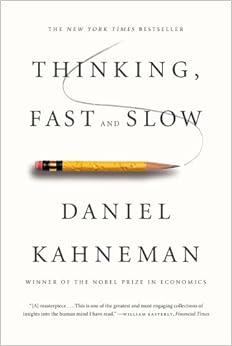
Thinking, Fast and Slow -- Daniel Kahneman --------------------------------- 4 Stars
Daniel Kahneman's Thinking, Fast and Slow is a monster. It's a monster in length, in scope of content, and in general premise. But, it's also quite awesome and highly recommended.
So, why 4 stars? Well, as I said, it's really quite good but it really is a challenging read. In the same vein as many other books about behavioral economics, Kahneman's basic goal is trying to explain to the readers how we think. To do so, he narrows down our brain to two simplistic parts, simply titled: System 1 and System 2. System 1 moves fast, very fast, instinctual fast. System 2 is slow, analyzing everything. System 1 does a vast majority of our everyday lives: read, breath, eat, walk, drive, etc. System 2 does the more complex stuff, but it asked to take things on far less often. The problem in life is that many things that we should be using System 2 for, System 1 takes on (silly System 1), and vice versa. So, basically the book is trying to explain and rectify these issues.
Overall, the book is fascinating. While I had seen many of the studies from it in other books on behavioral econ., like Predictably Irrational or Nudge, I still love the premise of this book, and though he gets way too deep on some things, the basic points of each chapters and large sections are fantastic. He has a great organization to the book and there is pretty good flow during his presentations from experiment to the other. It's really amazing how much though has gone in to understanding our thoughts and this, at least to me, is the most comprehensively explained books of this type.
The biggest drawback, however, and what kept it from a higher rating, was the length and difficulty to follow some of his writing. To me, Malcolm Gladwell, is one the best at simplifying complex ideas and taking rather scientific studies and making them clear to a laymen like myself. Kahneman, while nowhere near as difficult to follow as, say a scientific journal, does not have Gladwell's skills for being straightforward and clear. While one might think this is not a big deal, I agree it's not, until you ask someone to read over 500 pages and, by the end, they are begging for a better editor. So, yeah, it's kind of a rough read throughout many spots.
Overall, though, this book really is a gem. So many great experiments, so many wonderful points made, so many new ideas and concepts for the reader to think on, and so many interesting ways to better look at, and contemplate, human psychology. While you need to have a specific interest in this type of work to read this book, if you do have some time and can manage to wade through the deep end of the some these ideas, you will come out on the other side with a much better understanding of thinking.
So, why 4 stars? Well, as I said, it's really quite good but it really is a challenging read. In the same vein as many other books about behavioral economics, Kahneman's basic goal is trying to explain to the readers how we think. To do so, he narrows down our brain to two simplistic parts, simply titled: System 1 and System 2. System 1 moves fast, very fast, instinctual fast. System 2 is slow, analyzing everything. System 1 does a vast majority of our everyday lives: read, breath, eat, walk, drive, etc. System 2 does the more complex stuff, but it asked to take things on far less often. The problem in life is that many things that we should be using System 2 for, System 1 takes on (silly System 1), and vice versa. So, basically the book is trying to explain and rectify these issues.
Overall, the book is fascinating. While I had seen many of the studies from it in other books on behavioral econ., like Predictably Irrational or Nudge, I still love the premise of this book, and though he gets way too deep on some things, the basic points of each chapters and large sections are fantastic. He has a great organization to the book and there is pretty good flow during his presentations from experiment to the other. It's really amazing how much though has gone in to understanding our thoughts and this, at least to me, is the most comprehensively explained books of this type.
The biggest drawback, however, and what kept it from a higher rating, was the length and difficulty to follow some of his writing. To me, Malcolm Gladwell, is one the best at simplifying complex ideas and taking rather scientific studies and making them clear to a laymen like myself. Kahneman, while nowhere near as difficult to follow as, say a scientific journal, does not have Gladwell's skills for being straightforward and clear. While one might think this is not a big deal, I agree it's not, until you ask someone to read over 500 pages and, by the end, they are begging for a better editor. So, yeah, it's kind of a rough read throughout many spots.
Overall, though, this book really is a gem. So many great experiments, so many wonderful points made, so many new ideas and concepts for the reader to think on, and so many interesting ways to better look at, and contemplate, human psychology. While you need to have a specific interest in this type of work to read this book, if you do have some time and can manage to wade through the deep end of the some these ideas, you will come out on the other side with a much better understanding of thinking.
Sunday, June 1, 2014
Killer Angels -- Michael Shaara -------------------4 Stars
So, there is this old saying NBC had going for a while, "It's new to you." I think it was a way to promote and market people watching repeats of television shows. You know, if you have not seen something before, even if it's old, it's new to you. This make sense. I am watching the old Friday Night Lights TV series right now (btw, fantastic!) and all of it is new to me. All of this is a long way of saying that when I recently read Michael's Shaara's classic, Pulitzer Prize winning novel from 1987, Killer Angels, it was new to me, and it read as well I could have imagined if I picked it up when it came out.
Basically, its historical fiction for the three days of the Battle of Gettysburg. What is so cool about the book, though, is that Shaara takes each of the major generals, Lee, Chamberlain, Longstreet, Pickett, etc., and creates dialogue and scenes to mimic the action that occur during this pivotal battle.
I waited on reading this book for a little while after getting it as I was not convinced that I would enjoy it. I am not a big fan of historical fiction, in general, and am even less of a fan of any sort of books that detail war and events of battles. As such, I was pretty wary about reading a book about the 3 days of the very bloody Gettysburg battle. But I was so very pleased with what I got.
While this book is definitely about battles and includes a fair number of descriptions about the fighting, the book is really a story about people. Sure, the lens is the Civil War, but this book's description, dialogue, and expression of people's thoughts really is incredible. I loved the descriptions of each main character at the start, discussions that occur throughout the days while the battles are going, and incredible connections made between the characters and the reader. As a history teacher, this book truly helped me better understand and empathize with these soldiers but also, to more easily identify with the challenges of war through individuals.
I really recommend this book for nearly all readers. It's a great story, historically accurate (including plenty of maps), and is really a wonderful portrait piece about these different characters. Have no fear, this is not a book that glorifies battle in anyway, but does give you really good understanding of what some of the most critical soldiers thought during America's own Civil War. If that doesn't convince you, remember, it won the Pulitzer Prize, and if you haven't read it before, it will definitely be "new to you".
Basically, its historical fiction for the three days of the Battle of Gettysburg. What is so cool about the book, though, is that Shaara takes each of the major generals, Lee, Chamberlain, Longstreet, Pickett, etc., and creates dialogue and scenes to mimic the action that occur during this pivotal battle.
I waited on reading this book for a little while after getting it as I was not convinced that I would enjoy it. I am not a big fan of historical fiction, in general, and am even less of a fan of any sort of books that detail war and events of battles. As such, I was pretty wary about reading a book about the 3 days of the very bloody Gettysburg battle. But I was so very pleased with what I got.
While this book is definitely about battles and includes a fair number of descriptions about the fighting, the book is really a story about people. Sure, the lens is the Civil War, but this book's description, dialogue, and expression of people's thoughts really is incredible. I loved the descriptions of each main character at the start, discussions that occur throughout the days while the battles are going, and incredible connections made between the characters and the reader. As a history teacher, this book truly helped me better understand and empathize with these soldiers but also, to more easily identify with the challenges of war through individuals.
I really recommend this book for nearly all readers. It's a great story, historically accurate (including plenty of maps), and is really a wonderful portrait piece about these different characters. Have no fear, this is not a book that glorifies battle in anyway, but does give you really good understanding of what some of the most critical soldiers thought during America's own Civil War. If that doesn't convince you, remember, it won the Pulitzer Prize, and if you haven't read it before, it will definitely be "new to you".
Saturday, April 26, 2014
Monsters: The 1985 Chicago Bears - Rich Cohen ----------------------- 4 Stars
Some books that a person reads tend to hit home for a personal reason. Such is the case with Rich Cohen's wonderful Monsters: The 1985 Chicago Bears and the Wild Heart of Football. I bought this book for my father and he re-gifted it back after finishing and singing it's praises; he was right. It is very good and I was not disappointed.
While the main crux of the book is the '85 Bears SuperBowl team, arguably the greatest team of all time, the book is really a history of the Bears (and, by connection, football as well). Starting with the incomparable George Hallas' creation of the team and then Butkus, Ditka, Singeltary, Ditka again, and then Payton and McMahon, the reader learns a litany about the team. The book was so enjoyable to me as I knew very little about the history of the Bears or details about the players that were beyond my generation. Whether the beginning of the books stories about how the team was created to the amazing history of linebackers to the incredibly complex review of the '85 Bears team, including the inventive '46 Defense by Buddy Ryan, there is not one chapter that is not interesting and well created.
Normally, I would never recommend this book to any non-Bears or non-football fans, but in this case, I actually do think this book might be enjoyed by many types of readers. Certainly, being a Bears fan at heart will make this more enjoyable, Cohen's writing style and text is so rich that it's a breeze to read, easy to get through, includes great dialogue, and has great action. He has a very strong writing style that alllows the reader to really 'feel' the scenees he describes and never dwells on a topic too long. Each chapter finishes just when it's starting to perhaps feel a bit long and then he quickly shifts to a new person or event.
However, if you ARE a Bears fan, this is a must read! It's history of the team and interview with hundreds of individuals really bring you back to '85 and that incomparable team. Whether it be his summary of Duerson's career or the agile feats of Sweetness, #34 (both will be missed), this book is a beautiful tale about one of the greatest teams in Chicago sports history. While I figured the book would just be a decent, fairly dry historical memory, I was so pleased to have been treated to such a wonderfully crafted book. Rich Cohen certainly did the Bears proud! BEAR DOWN!
While the main crux of the book is the '85 Bears SuperBowl team, arguably the greatest team of all time, the book is really a history of the Bears (and, by connection, football as well). Starting with the incomparable George Hallas' creation of the team and then Butkus, Ditka, Singeltary, Ditka again, and then Payton and McMahon, the reader learns a litany about the team. The book was so enjoyable to me as I knew very little about the history of the Bears or details about the players that were beyond my generation. Whether the beginning of the books stories about how the team was created to the amazing history of linebackers to the incredibly complex review of the '85 Bears team, including the inventive '46 Defense by Buddy Ryan, there is not one chapter that is not interesting and well created.
Normally, I would never recommend this book to any non-Bears or non-football fans, but in this case, I actually do think this book might be enjoyed by many types of readers. Certainly, being a Bears fan at heart will make this more enjoyable, Cohen's writing style and text is so rich that it's a breeze to read, easy to get through, includes great dialogue, and has great action. He has a very strong writing style that alllows the reader to really 'feel' the scenees he describes and never dwells on a topic too long. Each chapter finishes just when it's starting to perhaps feel a bit long and then he quickly shifts to a new person or event.
However, if you ARE a Bears fan, this is a must read! It's history of the team and interview with hundreds of individuals really bring you back to '85 and that incomparable team. Whether it be his summary of Duerson's career or the agile feats of Sweetness, #34 (both will be missed), this book is a beautiful tale about one of the greatest teams in Chicago sports history. While I figured the book would just be a decent, fairly dry historical memory, I was so pleased to have been treated to such a wonderfully crafted book. Rich Cohen certainly did the Bears proud! BEAR DOWN!
Saturday, March 15, 2014
David and Goliath -- Malcolm Gladwell ------------------------- 3.5 Stars
I love Maclolm Gladwell books. I have read them all and think that Tipping Point and Blink are among my favorites. So, it was with great excitement I purchased his new book: David and Goliath. Normally, I borrow new books from the library as they are quite expensive, so I was so excited to see that this was available on Amazon for only $3.99; now I know why.
This book is very mediocre. Great premise: what people often think are weaknesses are actually strengths and areas where people think they have a disadvantage can be advantages. He starts off with some great chapters and continues his typical style of introducing a new 'anecdote' for each chapter and 'point' he is trying to make. The book starts off really strong. There is a great chapter about basketball and full court pressing and then moves on to talk about dyslexia and how many CEOs and other very successful people have dyslexia and have 'compensated' through having strengths in other areas.
Perhaps one of my favorite ideas he talked about was the idea of an inverted U. Basically, its a theory that talks about how as you go up in number it improves or changes things for the better until it gets too big then goes back down. The case he uses, which was very interesting, was class size. The point in the context for the book was: one assumes that smaller class size is always better but that's not true. Once you get to a certain number that is too small, the class actually gets worst. Same on the other end; so, you want the number in the middle.
Anyway, the book had a really solid first third. The last third was more difficult to get through. The stories were less interesting and less connected and less supportive of his overall thesis. In fact, some of the stories were just bad. I think the biggest problem with the book was the overall idea in general. With Tipping Point and Blink, Gladwell does such an amazing job of making you understand not just his theory but why its important to know in our lives today. While he tries to follow that same goal with this book, it falls more flat. The theory is not as good, the cases are not as supportive, and the writing is less exciting.
Nonetheless, I still recommend the book, especially if you are Gladwell fan. His writing style is still very engaging and the stories he offered are pretty interesting, especially at the start. It's not a long read and is pretty easy to get through so I would definitely recommend.
This book is very mediocre. Great premise: what people often think are weaknesses are actually strengths and areas where people think they have a disadvantage can be advantages. He starts off with some great chapters and continues his typical style of introducing a new 'anecdote' for each chapter and 'point' he is trying to make. The book starts off really strong. There is a great chapter about basketball and full court pressing and then moves on to talk about dyslexia and how many CEOs and other very successful people have dyslexia and have 'compensated' through having strengths in other areas.
Perhaps one of my favorite ideas he talked about was the idea of an inverted U. Basically, its a theory that talks about how as you go up in number it improves or changes things for the better until it gets too big then goes back down. The case he uses, which was very interesting, was class size. The point in the context for the book was: one assumes that smaller class size is always better but that's not true. Once you get to a certain number that is too small, the class actually gets worst. Same on the other end; so, you want the number in the middle.
Anyway, the book had a really solid first third. The last third was more difficult to get through. The stories were less interesting and less connected and less supportive of his overall thesis. In fact, some of the stories were just bad. I think the biggest problem with the book was the overall idea in general. With Tipping Point and Blink, Gladwell does such an amazing job of making you understand not just his theory but why its important to know in our lives today. While he tries to follow that same goal with this book, it falls more flat. The theory is not as good, the cases are not as supportive, and the writing is less exciting.
Nonetheless, I still recommend the book, especially if you are Gladwell fan. His writing style is still very engaging and the stories he offered are pretty interesting, especially at the start. It's not a long read and is pretty easy to get through so I would definitely recommend.
Subscribe to:
Posts (Atom)