Sunday, October 19, 2014

The Breaks of the Game -- David Halberstam -------------------------- 3 Stars

David Halberstam's The Breaks of the Game, is by all accounts, an absolute classic about the growth of the National Basketball Association.  Written over 30 years ago, I had heard about it being a 'phenomenal' book on many occasions.  Well, it was about time I gave it a spin to see what I thought.

What I did I think about it?  I'm still grappling with that question a little bit.  I know it was a fairly long book that seemed to be written with no real organization.  Although my Kindle said it was only 270 pages, the pages must be gigantic or have very large print.  It would take me many minutes just to finish a page.  Also, it seemed to just wander along going from one story to the next with no real organization or strategy to the order.  The backdrop behind all of it is the study of the Portland Trailblazers the year after they won the NBA championship with a great team led by Bill Walton.  That was about the only structure that existed.  I think it only had 4 chapters in the entire book and one of the chapters was about 200 pages by itself with no real demarcations from one subject to the next.  So, it was a bit hard to read.

I also did not love Halberstam's writing style.  I know he has been named one of the great writers of this generation, but I found his style frustrating as it would go from being short, succinct and somewhat informal to longer passages with a formalized structure that was not as appealing.  He also struggled to really grab me, as the reader, on many occasions.  I am not sure if it was because the stories were so dated or just, perhaps, boring and uninteresting, but it was a major problem of the book.  Also frustrating was the quite obvious lack of basketball information.  Make no mistake, this book is about a time period, really, society, entering the 1980s and how that had changed, especially socially, in the past 10 years.  All that is great and fairly interesting, but if you notice above, their is a giant picture of a basketball; kind of what I was hoping to read about.

But there was good stuff.  It's still a pretty fascinating portrayal, and as far as I can tell, incredibly accurate portrayal of what this nascent NBA was all about.  The story lines about Bill Walton, some of the other players, and the Trailblazers management was truly fascinating.  When Halberstam did take a few stanzas to describe basketball being played, it was quite lovely.  In fact, his descriptions of Walton and his true love of the game when it's being played at its best, was beautiful.  It truly can be a beautiful team game.  Also great was getting to really understand how much basketball is a profession at that level and not the joy that many people think it to be.  It's a grind, and in those days, it was a really hard grind as the money was just not great (many of the smarter athletes didn't even go to the NBA as it was a financial loss).

Overall, I do suggest reading this book if you want to truly have a consummate look at what society is like as the 1970s end and '80s begin.  The backdrop will be a small basketball team from the Pacific Northwest, but the stories told are examples from across the country.  Just know that it will take some real investment to stay connected with the text as you go through it.

Saturday, September 6, 2014

Defending Jacob -- William Landy --------------------- 4.5 Stars

I was a bit nervous about reading a third book in a row about murder.  I mean, there's only so much you can take, and even though this was fictional, I was worried.  But, I lucked out and read and awesome book in William Landy's Defending Jacob.

This book is an easy, fun read.  Basic premise, the guy telling the story is a district attorney in a small town.  A murder occurs and his son ends up being looked at as a suspect and eventually is put on trial.  The book follows, in real time, what is occurring in his case while jumping back in the past to explain the lead up to the present part of the book.  It's a nice way of writing and keeps you interested on both time lines.

So, why does this seemingly simple, rehashed plot type done many times before, earn 4.5 stars?  Because it does what it does really well.  First, it's an awesome story.  It's got good characters and a superb plot.  It's told in a fun way and it keeps you guessing.  Second, it's got a lot of great dialogue.  As people know, I am big dialogue guy.  So, the exchanges with lawyers and witnesses was superb and the infighting that occurs between the 'good' guys and 'bad' guys was great.  Third, it's an easy read.  Not super long, crisp and fun dialogue.  Lots of chances to put down and pick back up easily.  Lots of exciting chapter endings to keep you going.  Fourth, the book has no major weak spots.  As I was near the end I thought to myself, there is only one thing that can ruin this book and it's a bad ending.  Well, guess what, great ending.  Ties things up well, little bit of a twist.  Truly enjoyable.

So, this sounds pretty great, right?  Well it is.  The only thing is it's not a 5 star book.  It's not epic.  It's not something that you HAVE to read at some point in your life.  It's incredibly entertaining but it's still a simple (although really awesome) legal thriller.  My only small nits worth picking is that the ending doesn't really tie everything together and, on occasion, the book gets a bit slow through it's covering of various parts of the legal proceedings.

Overall, you really want to check out this book if you have not read before.  It was a standout novel and really fun and easy read.  I doubt you will not regret it and will certainly have some thoughts on the ending and what happened.  Enjoy!

Monday, August 11, 2014

Lost Girls: An Unsolved American Mystery -- Robert Kolker ------------------- 2.5 Stars

Robert Kolker's new book Lost Girls promised to be an exciting, unsolved mystery about what happened to 5 young woman near New York city that went missing; it accomplished half of that, it was certainly unsolved but not all that exciting.

The basic set up of the book is divided into three parts.  It starts with biographies about each of the 5 girls.  Where they grew up, the type of families they had, the struggles they faced in their lives, etc.  The second part was about their move to NYC and their lives as prostitutes.  The final part was about the mystery of who may have killed them and the putting together facts to better understand what may have happened to lead to their deaths.  As it was, all were found in very close proximity to each other in similar ways (except for one girl who went missing after running off in the middle night loudly from a neighborhood.  She was the girl who started the whole search that found the other bodies though ironically was found last and not as close to the group). 

So, the basic premise as described above was pretty interesting and something that I thought would be a great read.  And it was; it started out very well with a superb description about each girl's history and their lives.  In fact, by the time they go into prostitution and end up going missing, you really do feel for each of them and their families.  The problem with the book is the last third: the search for the girls.  As the title makes clear, though the author never blatantly notes it, this is an UNSOLVED mystery.  Which in no uncertain terms means there is no real ending.  Kolker basically meanders through all the evidence, witnesses, suspects, and tries to juxtapose what might have happened and you are left with ..... nothing.  I know little more about who might have done it then I did on page 1.  Really there is no good evidence or information about who killed these girls (though one can assume pretty sure it was some guy who found them on Craiglists ads). 

Overall, the book is not awful.  It's just not great either.  It is a mystery but just not a very interesting one.  Though the author is pretty good at developing characters and making you connect with them on a general level not having any real sense as to what occurred really made the book suffer.  I am sorry if I ruined the ending for you but, as I said there is really no ending anyway, so in many ways I saved you the time from reading the book.  Nonetheless, if you are inclined to read it do know that it is a true story with some pretty sad themes running through it and pretty empty ending.

Saturday, July 19, 2014

The Dinner -- Herman Koch -------------------------------- 3.5 Stars

So, it's that time of summer where it's a bit of a challenge to find an interesting book.  Sure, there are plenty of good ones supposedly but when there is only a very finite amount of time to give to reading, you have to pick carefully.  Do you want to do a 1,000 pager?  Not really.  How about only non-fiction?  Fine with me but probably best to mix it up with some real literature from time to time.  So when I heard that Herman Koch's The Dinner was booked as a 'European Gone Girl', I was in.

Let's be clear early on, this book is, in some ways, like Gone Girl but it is not nearly as good.   They both have a very similar style to them and follow a very fun little routine.  If you've read either, you know what I'm talking about.  The story starts out pretty nonchalant with everything seemingly above board.  All the characters seem like they are really quite normal and nice and everything is going swimmingly with not any real questions of danger or concern.   Then, of course, things slowly start to unravel.  Small things start to become bigs ones and all of a sudden you start thinking to yourself "wow, there's some really weird stuff going on". 

This book follows the story line mentioned above.  In this case, it all seems fine with a typical European wife and husband going out for dinner with the husband's brother-in-law.  As they have dinner, though, we get some flashbacks to some previous events that occurred between their two families and all of a sudden I'm thinking to myself, "What a second, things are really getting strange... could it really be __________________?"

So, obviously, the book is a bit of a mystery that you need to read to find out more info. about.  It's a pretty fun read but it does start awfully slowly and takes much longer to 'get into it' than Gone Girl.  It's not nearly as gruesome either but it does have some great twists and is a super easy read.  Between it being a very short overall story, lots of dialogue, and the simplicity of being able to follow it, I was able to finish it in only a week or two.

I do encourage people to pick it up.  It's quite entertaining, and if you are a fan of Gone Girl or any stories with some good twists, you will enjoy this one.  Just remember that it's not the real McCoy and take your time to read some other mysteries before you get to this one. 


Saturday, June 21, 2014

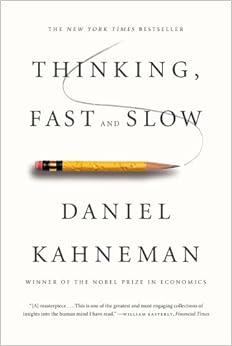
Thinking, Fast and Slow -- Daniel Kahneman --------------------------------- 4 Stars

Daniel Kahneman's Thinking, Fast and Slow is a monster.  It's a monster in length, in scope of content, and in general premise.  But, it's also quite awesome and highly recommended.

So, why 4 stars?  Well, as I said, it's really quite good but it really is a challenging read.  In the same vein as many other books about behavioral economics, Kahneman's basic goal is trying to explain to the readers how we think.  To do so, he narrows down our brain to two simplistic parts, simply titled: System 1 and System 2.  System 1 moves fast, very fast, instinctual fast.  System 2 is slow, analyzing everything.  System 1 does a vast majority of our everyday lives: read, breath, eat, walk, drive, etc.   System 2 does the more complex stuff, but it asked to take things on far less often.  The problem in life is that many things that we should be using System 2 for, System 1 takes on (silly System 1), and vice versa.  So, basically the book is trying to explain and rectify these issues.

Overall, the book is fascinating.  While I had seen many of the studies from it in other books on behavioral econ., like Predictably Irrational or Nudge, I still love the premise of this book, and though he gets way too deep on some things, the basic points of each chapters and large sections are fantastic.  He has a great organization to the book and there is pretty good flow during his presentations from experiment to the other.  It's really amazing how much though has gone in to understanding our thoughts and this, at least to me, is the most comprehensively explained books of this type.

The biggest drawback, however, and what kept it from a higher rating, was the length and difficulty to follow some of his writing.  To me, Malcolm Gladwell, is one the best at simplifying complex ideas and taking rather scientific studies and making them clear to a laymen like myself.  Kahneman, while nowhere near as difficult to follow as, say a scientific journal, does not have Gladwell's skills for being straightforward and clear.  While one might think this is not a big deal, I agree it's not, until you ask someone to read over 500 pages and, by the end, they are begging for a better editor.  So, yeah, it's kind of a rough read throughout many spots.

Overall, though, this book really is a gem.  So many great experiments, so many wonderful points made, so many new ideas and concepts for the reader to think on, and so many interesting ways to better look at, and contemplate, human psychology.  While you need to have a specific interest in this type of work to read this book, if you do have some time and can manage to wade through the deep end of the some these ideas, you will come out on the other side with a much better understanding of thinking.

Sunday, June 1, 2014

Killer Angels -- Michael Shaara -------------------4 Stars

So, there is this old saying NBC had going for a while, "It's new to you."  I think it was a way to promote and market people watching repeats of television shows.  You know, if you have not seen something before, even if it's old, it's new to you.  This make sense.  I am watching the old Friday Night Lights TV series right now (btw, fantastic!) and all of it is new to me.  All of this is a long way of saying that when I recently read Michael's Shaara's classic, Pulitzer Prize winning novel from 1987, Killer Angels, it was new to me, and it read as well I could have imagined if I picked it up when it came out.

Basically, its historical fiction for the three days of the Battle of Gettysburg.  What is so cool about the book, though, is that Shaara takes each of the major generals, Lee, Chamberlain, Longstreet, Pickett, etc., and creates dialogue and scenes to mimic the action that occur during this pivotal battle.

I waited on reading this book for a little while after getting it as I was not convinced that I would enjoy it.  I am not a big fan of historical fiction, in general, and am even less of a fan of any sort of books that detail war and events of battles.  As such, I was pretty wary about reading a book about the 3 days of the very bloody Gettysburg battle.  But I was so very pleased with what I got.

While this book is definitely about battles and includes a fair number of descriptions about the fighting, the book is really a story about people.  Sure, the lens is the Civil War, but this book's description, dialogue, and expression of people's thoughts really is incredible.  I loved the descriptions of each main character at the start, discussions that occur throughout the days while the battles are going, and incredible connections made between the characters and the reader.  As a history teacher, this book truly helped me better understand and empathize with these soldiers but also, to more easily identify with the challenges of war through individuals. 

I really recommend this book for nearly all readers.  It's a great story, historically accurate (including plenty of maps), and is really a wonderful portrait piece about these different characters.  Have no fear, this is not a book that glorifies battle in anyway, but does give you really good understanding of what some of the most critical soldiers thought during America's own Civil War.  If that doesn't convince you, remember, it won the Pulitzer Prize, and if you haven't read it before, it will definitely be "new to you". 

Saturday, April 26, 2014

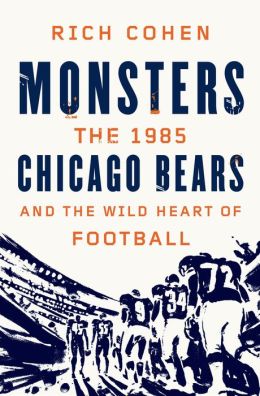
Monsters: The 1985 Chicago Bears - Rich Cohen ----------------------- 4 Stars

Some books that a person reads tend to hit home for a personal reason.  Such is the case with Rich Cohen's wonderful Monsters: The 1985 Chicago Bears and the Wild Heart of Football.   I bought this book for my father and he re-gifted it back after finishing and singing it's praises; he was right.  It is very good and I was not disappointed.

While the main crux of the book is the '85 Bears SuperBowl team, arguably the greatest team of all time, the book is really a history of the Bears (and, by connection, football as well).  Starting with the incomparable George Hallas' creation of the team and then Butkus, Ditka, Singeltary, Ditka again, and then Payton and McMahon, the reader learns a litany about the team.  The book was so enjoyable to me as I knew very little about the history of the Bears or details about the players that were beyond my generation.  Whether the beginning of the books stories about how the team was created to the amazing history of linebackers to the incredibly complex review of the '85 Bears team, including the inventive '46 Defense by Buddy Ryan, there is not one chapter that is not interesting and well created. 

Normally, I would never recommend this book to any non-Bears or non-football fans, but in this case, I actually do think this book might be enjoyed by many types of readers.  Certainly, being a Bears fan at heart will make this more enjoyable, Cohen's writing style and text is so rich that it's a breeze to read, easy to get through, includes great dialogue, and has great action.  He has a very strong writing style that alllows the reader to really 'feel' the scenees he describes and never dwells on a topic too long.  Each chapter finishes just when it's starting to perhaps feel a bit long and then he quickly shifts to a new person or event.

However, if you ARE a Bears fan, this is a must read!  It's history of the team and interview with hundreds of individuals really bring you back to '85 and that incomparable team.  Whether it be his summary of Duerson's career or the agile feats of Sweetness, #34 (both will be missed), this book is a beautiful tale about one of the greatest teams in Chicago sports history.  While I figured the book would just be a decent, fairly dry historical memory, I was so pleased to have been treated to such a wonderfully crafted book.  Rich Cohen certainly did the Bears proud!  BEAR DOWN!

Saturday, March 15, 2014

David and Goliath -- Malcolm Gladwell ------------------------- 3.5 Stars

I love Maclolm Gladwell books.  I have read them all and think that Tipping Point and Blink are among my favorites.  So, it was with great excitement I purchased his new book: David and Goliath.  Normally, I borrow new books from the library as they are quite expensive, so I was so excited to see that this was available on Amazon for only $3.99; now I know why.

This book is very mediocre.  Great premise: what people often think are weaknesses are actually strengths and areas where people think they have a disadvantage can be advantages.  He starts off with some great chapters and continues his typical style of introducing a new 'anecdote' for each chapter and 'point' he is trying to make.  The book starts off really strong.  There is a great chapter about basketball and full court pressing and then moves on to talk about dyslexia and how many CEOs and other very successful people have dyslexia and have 'compensated' through having strengths in other areas. 

Perhaps one of my favorite ideas he talked about was the idea of an inverted U.  Basically, its a theory that talks about how as you go up in number it improves or changes things for the better until it gets too big then goes back down.  The case he uses, which was very interesting, was class size.  The point in the context for the book was: one assumes that smaller class size is always better but that's not true.  Once you get to a certain number that is too small, the class actually gets worst.  Same on the other end; so, you want the number in the middle. 

Anyway, the book had a really solid first third.  The last third was more difficult to get through.  The stories were less interesting and less connected and less supportive of his overall thesis.  In fact, some of the stories were just bad.  I think the biggest problem with the book was the overall idea in general.  With Tipping Point and Blink, Gladwell does such an amazing job of making you understand not just his theory but why its important to know in our lives today.  While he tries to follow that same goal with this book, it falls more flat.  The theory is not as good, the cases are not as supportive, and the writing is less exciting.

Nonetheless, I still recommend the book, especially if you are Gladwell fan.  His writing style is still very engaging and the stories he offered are pretty interesting, especially at the start.  It's not a long read and is pretty easy to get through so I would definitely recommend. 

Saturday, March 1, 2014

Masterminds and Wingmen -- Rosalind Wiseman ----------------------------- 2.5 Stars

Masterminds and Wingmen seemed a book worth reading when I heard about.  It's written by the same author who wrote Queen Bees and Wannabes, which went on to be the basis for the movie Mean Girls, and was supposed to be one of the best books to really describe and help to have people understand girls.  Masterminds and Wingmen, is supposed to be the same version for boys.  Seeing as I have a 3 year old son and work with many boys in school, I thought it would be a very relevant book in my life.  Unfortunately, it did not live up to my expectations.

The book is okay.  It starts off very interesting and I was quite engaged at the beginning but as it went on, it became harder and harder to stick with it.  In fact, the last chapter (the longest?) about girls and dating, I was on total skim mode.  In general, the premise of it is pretty good: she talked with a whole bunch of adolescent boys, they shared their 'secrets' and then she organized and explained what to make of those for the average reader to better understand.  So, on a positive, it did provide me some interesting glimpses into the way boys think and act.  It did make me question some of my assumptions about boys and it definitely made me think back to when I was a kid and a few indiscretions I had.  The book certainly had moments of really good points when she talked about strategies that she thinks work well with boys in various situations.  But those useful strategies were few and far between.

Sadly, the book had far more negatives going for it.  First, its a long read and I struggled with her writing style.  Besides writing in a incredibly familiar tone (I'm pretty sure she's not actually my friend), she comes off as very pretentious and as if she's an expert.  As it's a type of 'self-help' book, I get that, but rarely did she ever doubt what she was saying nor do I really understand her qualifications.  Second, this book  is really for a very specific group in society.  Middle-upper class white people; further, probably just mothers.  Almost all the problems she discusses are based on this group of society and it was constantly annoying how she explained clearly what a mother should do but rarely mentioned a father.  Third, I was hoping this book would actually provide me a lot of new ideas.  It did not, perhaps because I am in education, I knew many of what she suggested, but I found much of this elementary.  Perhaps there are parents out there that could really get a lot of it?  Finally, the best part of her book, the quotes from students, were often just segways and setups for the next section or point in her book.  I really wish she would have spent more time with what they said and had more explanation.

So, perhaps this book is good for you.  If you loved her last book, are a clueless person with kids, or really feel you don't understand boys that well, than this would be a worthwhile read.  For me, I'll pass on any future books by her for a while... now if a movie comes out, I guess I could give  a couple hours to that :)

Sunday, January 19, 2014

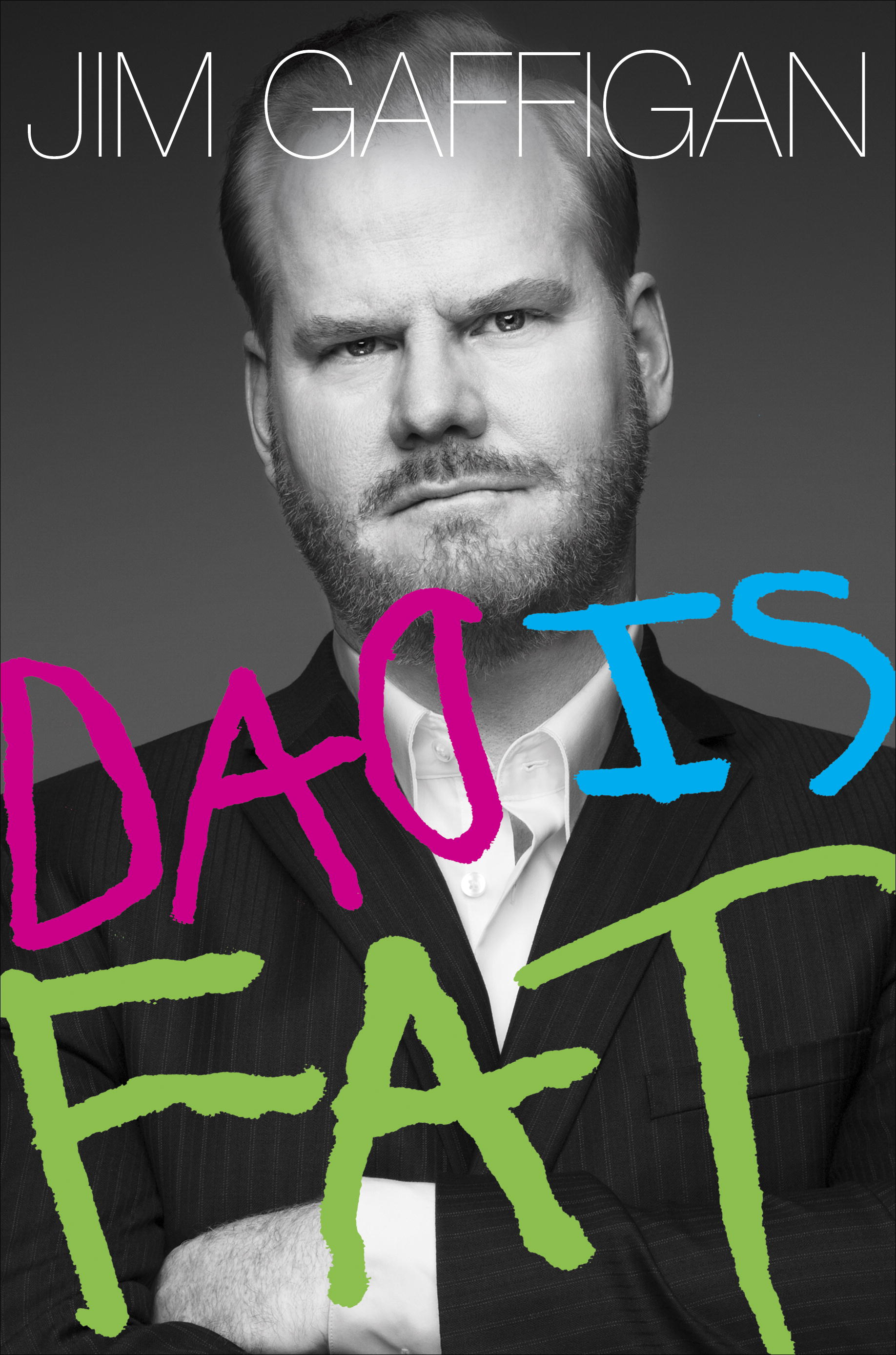
Dad is Fat -- Jim Gaffigan -- 2 Stars

If you are not aware of the comedian Jim Gaffigan, I would definitely take the time right now (STOP READING!) and go check him out.  He is very funny; he talks about Pop Tarts and Hot Pockets and being pale... it's quite good.  Unfortunately, his book, Dad is Fat is not anywhere near the same level as his comedy. 

On a positive side, the book is an easy read and does have some very good jokes and stories.  In fact, much of the book is based around anecdotes from his life as a father.  He has 5 kids and lives in the NYC, so there are some very funny stories.  I like the stories he tells and points he makes in the book.  Certainly, there are times when I laughed out loud (when he talks about feeding kids, he says if you are going to give your 3 year old a taco, you might as well just throw it on the floor and save some time), but for the most, it was alot of stories that were not super funny but were occasionally interesting.

The biggest problem of the book, is that it is really set up as a book that is supposed to be funny and make you laugh.  So, normally, a book you read is interesting because of the content and points it might makes (or stories it tells, if fiction).  While this book does try to make certain points (i.e. 5 kids is a lot), it's mostly set up to be funny.  As I said, though, it really wasn't that funny.  I mean, when you see him do stand-up it's like 45 minutes of jokes and there is the whole way it's told, facial expressions, etc.  In a 200 page book, the joke stands alone on the page and, if you were to read it out loud, it would probably take hours.  My point: there's only so much good material and it's very hard to keep it up through a whole book.

I gave it 2 stars as there were numerous times reading it when I was dreading having to continue.  While I did not really dislike it, it wasn't doing much for me.  The jokes were few and far between, the anecdotes were short and not all that interesting.  Normally, when I read a fiction book, its a great story; this was not.  When I read non-fiction, I am usually learning something; I did not much here (again, besides knowing 5 kids is a lot).

So, if you are a huge Jim Gaffigan fan or do enjoy humor about raising kids, this might be up your alley.  Or, if you are a reader with a lot of time and just enjoy simple stories, this might be good.  But, if you expect a bit more to think about when you reading, do give some of the higher rated books on my blog a try first. 

Monday, December 23, 2013

Sharp Objects - Gillian Flynn ---------------------- 2.5 Stars

It was not long ago I finished Gillian Flynn's smash hit Gone Girl, which earned a very solid review from me back in August.  It only seemed like a natural to check out her earlier book Sharp Objects when a friend recommended.  I don't if my expectations were so high after reading Gone Girl, or if the book is just not good, but I was not a big fan.

If you had the pleasure of reading Gone Girl (which, if you haven't, you really should stop reading this right now and go pick that up) you know how great a gruesome mystery novel can be. Riddled with great plot elements, crazy characters, and a side of yuckiness that worked perfectly together, it was a great novel.  I think Flynn tried to do the same with this book, but it just didn't work as well.  (Side note: this actually came first so I probably shouldn't compare them that way; maybe this book helped her get to Gone Girl :) ). 

Basic plot -- newspaper writer who follows the crime beat, goes back to small town in Missouri she grew up in to cover the story of two murders of young kids.  Shocking, she gets woven into the craziness of the town and has something to do with the killer/killings.  So, not a bad set up, but we have some problems.

Problems:
1. I never bought into the character as she just never seemed real to me.
2. Some of the story lines were so ridiculous especially those of her 13 year old sister and crazy mother
3.  I never bought into some of the workings of the police and cops
4.  There was minimal action and the "mystery" was so slow to develop
5.  Some of it was just gross

There were some good parts though.  It WAS fairly entertaining and an easy read.  It had a lot of dialogue, which I like and the story was pretty scary so it kept me interested for the most part (just slow).

Overall, do yourself a favor and check out Gone Girl if you haven't yet.  If you love it, and are okay with a second best novel with similar theme and set up, then read Sharp Objects, otherwise, I say it's a skip.

Monday, December 9, 2013

How Children Succeed -- Paul Tough ------------------------ 4 Stars

I try not to read too many education books during my free reading time.  As I do it for a living, it's nice to have a get a way sometimes as I spend time with it all day long.  So, when I do read education focused books, those that are written in a 'non-academic' way, are the easiest to get through.  Those that are also quite interesting are a big bonus.  So, Paul Tough's How Children Succeed was a pleasure it was an easy and fascinating text. 

The subtitle of this book is "Grit, Curiosity, and the Hidden Power of Character", you can probably gather that the main focus of the book is the author's claim that how much effort a students put into school is the most important element of success.  This goes counter to what many believe, as most think student's IQ and intelligence is the main determinant of future well being.  Needless to say, I truly enjoyed the idea behind his premise and believe in it fully.

The book is a quick, easy read and he does a fine job of relating a variety of anecdotal and data drive information to prove a variety of points.  Written in a "Gladwellesque" style, the reader goes from chapter to chapter being told interesting story after interesting story all to make certain points clearer and more easy to believe. 

While I think Tough's major push in the book was to get a wide audience to read the book in a bigger context of looking at students in a whole in our educational system, he really does a bait and switch as his true goal is to make the reader aware of his biggest area of interest: poor students in under performing schools.  Don't get me wrong, I still think it's a great book and well argued, but the major case he is making are for specific ways we could change the system to make massive saves of a consistently under performing, and often forget about, group.  He reminds me a lot of Jonathan Kozol, for you fans of him.

No real drawbacks besides the fact that the book does not fully deliver on the expectation of the title.  Additionally, it does kind of get bogged down in some areas and I don't think he hammers home his points as well as possible.  Also, as I judge mostly on entertainment value, this book does pretty well but it's still a book about education, albeit, an awfully good one that I urge you to read even if you are not an educator as it gives you great insights into why people are successful.

Sunday, November 17, 2013

Walden on Wheels - Ken Ilgunas ----------------------- 2.5 Stars

Lately, I have been reading far more books on my Kindle than on paper.  Usually, I borrow them from Arlington or Montgomery County.  You can't get new releases very easily but any older books, it is a quick and FREE download.  So, when I saw the newly released Walden on Wheels  on Kindle for only $4, I thought it was certainly worth the download.  I now know why it's only $4... at best, that's its value. 

You should understand the premise: some kid in graduate school decides he can't stand having any student debt so he decides to live in a van during his time in school.  There is an implicit and explicit kinship with Thoreau's Walden, hence the name of the book. 

Overall, the book is, OK.  It's not awful, but is also not very good.  It starts with a very exciting entry of this dude in his van about to potentially be found out by the cops while on campus.  The book then sprawls in to the next couple hundred pages of the back story that brought him to that point.  I remember this specifically as I was at the 66% notification on my Kindle when the book finally got back to the point at which it started.  That first 66% of the book is a bit rough.  Stories about this guy's lust for the wilderness, living differently, and issues with society litter most of the novel.  While you might appreciate his view on life, it gets old after a while and his constant stories about returning to Alaska (which I think he did for, what felt like, every summer of his life) wore after a while.

The good parts were the last third of the book for sure, along with a fairly informal and enjoyable writing style.  You do, sort of, feel for the protagonist and friend's plight as many had a similar one.  Go to college with no real goal, go into massive debt, finish college and have no real way to pay off debt or utilize degree earned.  Unlike the author and buddy though, I never felt the need to 'fight' society for all of it's ills and assure I go against the system.  While I appreciate freedom (truly, the ultimate goal of the author), it's not worth the cost of security and assurance of safety. 

In general, the book is probably worth the $4 price tag.  It's sort of a novel idea, fairly interesting, and not the worst piece of writing.  However, it's certainly not a great read and you have to really enjoy the philosophies put forth of the author as they are fairly pervasive and make up the large amount of the novel whenever the reader begins to question why in god's name does he live in a van?  Enjoy!

Sunday, October 13, 2013

The Twelve -- Justin Cronin ----------------- 3 Stars

You may remember a few months ago when I raved about Justin Cronin's The Passage.  It was one of the few books that I have reviewed to ever garner 5 stars.  Well, lo and behold, I found it is a trilogy (which really makes me feel better about the ending of the first book :)).  The second book in the trilogy is The Twelve.  As I had finished the previous book less than 4 months ago, I was very excited about reading the follow-up...as you can guess from my rating, it did not impress like the first.

One of the things that made me so excited about reading this book was to find out what happened to some of the characters of the other book.  Well, I did found out what happened to them, unfortunately, it took about 250 pages to get to that point.  To say this book started 'slow' is a massive understatement.  In fact, I'm not sure if I would have kept going if this was a book I just picked up for the first time and had no history with the author or story.  But, I kept going and the book slowly got better.

The good -- The book does keep you up about the favorite characters from the last story.
The book is still well written, and if you can keep with the story after the slow start, is quite good
The book had an ending, of sorts, while still making you excited about the final book in the trilogy
The book is still a great story about good vs. evil

The bad -- Like I said earlier, really slow start
The book is all over the place and jumps around far more often than the previous book
The book seems to not connect some events until much, much later
The books focus is on many of the smaller characters from the last book or on new characters.  While this is nice in some ways, it is a shame to get away from some of the characters that were so well established and love from the previous book.

Overall, it is a must read if you read The Passage and were a fan of it.  Although not a great book, it is still quite good if you liked the first book and is a book you have to read if you are going to continue the trilogy.  I am really excited about finishing the trilogy with Justin Cronin's next book that comes out next year. 


Sunday, August 18, 2013

Dream Team -- Jack McCallum ------------------- 3 Stars

I don't really have a lot to write about today.  Partly it's because school starts very soon and time is not nearly as plentiful as it is earlier in the summer, and the book Dream Team by Jack McCallum really does not inspire me to write a great deal.

The book, as you can probably guess from title and cover picture, is about the 1992 Dream Team that won gold in basketball in Barcelona.  I love basketball and I loved this team (back at the ripe old age of 12) at the time so I thought this book would bring back great memories, have great insights, and be a real page turner... it was all of those things but only in some very small quantaties.

The good --
It's an easy read and I breezed through in about a week
It did have some great insights about how the team was originally created (sorry, Isiah Thomas), how they interacted with each other, and what life was like for some of the greatest players to ever play the game
The best part were the stories about the guys and their personal lives that I was never aware (a few: Stockton was so unrecognizable he would walk around Spain asking people about himself, Barkely would go out all night, Jordan was obsessed with beating everyone at everything, Laetner's best ability might be his ping pong skills (he beat Jordan)).  There were a few others about a great scrimmage within the squad a well.

The bad --
You just got most of the highlights above... I mean obviously there is more but I really felt like I was reading a book that could have been condensed to about 100 pages from 300.
It became really annoying how often the author had to talk about himself.  I assume Jack McCallum has been around for a while and is some big shot for SI, but does every chapter have to include some reference to his own part in this?  Jeez.
Much of the book I was already aware of or knew about so it was a bit repetitive for me
I didn't love his style of writing.  Although easy to read it was told in a very boiler plate kind of way and had little excitement.  


So, overall, I would pick this up if you are a die hard b-ball fan or love the Dream Team otherwise I would avoid.  While a few of the nuggets from this made the press (i.e. Isiah was left off cause MJ didn't want him), you can just check the old news and learn that stuff. 


Thursday, August 1, 2013

Gone Girl -- Gillian Flynn --------------- 4.5 Stars

Not long ago I wrote about the phenomenon where something is such a big hit, that I almost feel stupid to not check it out.  Almost always, when I do then check it out, it invariably is quite awesome and there is a reason that everyone loves it (I'm to lazy to find the old post but I had a few examples to prove).  That's kind of the reason I eventually decided to read Gillian Flynn's Gone Girl.  While I knew the book was incredibly popular and saw the cover everywhere, I thought it was your average (excuse the awful upcoming stereotype) "chick" novel.  You know, the Nicholas Sparks, they love each other so much that I have to throw up in my mouth now; but, oh no, this book was quite different.  This was, oh my god these people hate each other and maybe have murdered one another... so yeah, it was awesome.

So the basic premise that had me finally pick up the book was the realization that this book was really about a quite dysfunctional marriage that eventually leads to the wife going missing (hence the title).  What's so great about the book though, is the story that goes with it.

There were a number of things I loved about the book.  First, the actual story is awesome.  I mean, it is a great mystery, it constantly keeps you guessing, you can't wait to read the next chapter or entry.  It's great.  Second, I love the way it is told.  Basically, you have a sort of 'present' day version of the events told by the husband and then every other chapter is a 'past' version of events told by the wife.  At some point the two entries catch up with each other and you basically then get the same version of events from a very different point of view.  The book also has three distinct parts that make the actual story and how it's told even more interesting.  Great format.  Third, she is a very good writer.  Not in the, 'wow, I can't believe how beautiful that sentence was', but more of the 'wow, this lady is pretty cool and really understands people and the modern society we live in' writing.  She kind of reminds me of how Jonathan Franzen writes some things.  Major note though, the book is quite vulgar in both language and lewdness.

Small drawbacks: as I just said, pretty raunchy.  More of an issue though, the ending.  In some ways the ending was set up to be a disappointment.  The book is so exciting and mid to late chapters so interesting, that in many ways the climax of the book happens far before the end and the ending then is almost the tying of up loose ends.  I guess the book is really so good and interesting that it could not keep up its inertia all the way through.  Most books have a plot that moves forward, climax right before the end and then the sort of outcome or finalization of the climax (I think this is called denouement, if it is my high school english teacher did a nice job).  Anyway, this book did that but the rising action finished with like a quarter of the novel left... odd.

Big picture -- this book earned 4.5 stars.  It's very, very entertaining.  An easy and enjoyable read.  One of the few books I read recently where I actually slowed down because I wanted to revel in it and enjoy it longer.  No 5 stars just because it's not epic and the writing is quite crude (along with many of themes around sex and violence).  I still urge you to pick it up.  It's quite popular and there is a definite reason for that.

Tuesday, July 16, 2013

Inferno -- Dan Brown ------------------ 3.5 Stars

On occasion, I read a book and I really want to give it a better rating but usually it lacks excitement or 'entertainment value' and I do not.  As I have been doing since the start, I tend to do my ratings based on how entertaining the book is.  In the case of Dan Brown's Inferno, it's the opposite.  This is a book that should have received a lower rating for a variety of reasons, but wouldn't you know, it was a really fun, interesting read that I felt obligated to give a decent rating.

Unless you've been living under a rock for the past 10 years, you probably read/saw/or heard about Dan Brown's The Da Vinci Code.  It was a great, repeat, GREAT book.  Inferno was not, repeat, NOT a great book... it wasn't even a good book.  I am not sure what happened; it's hard to tell how much is the book and how much is me.  A really similar thing happened a few years ago when I read a John Grisham book for the first time in a while.  It was called The Appeal and the review is here, but bottom line is, things that seem really cool when you are younger, aren't as cool nowadays.  As a case in point, Dan Brown's Da Vinci Code was soooo cool.  It was interesting, and educational, and fun, and seemed accurate in a good way while Inferno, while interesting, does not seem that educational, was not nearly as fun, and while possibly accurate, far less of usefulness and consequence.  Overall, just not nearly as good a book.

I guess it's just hard to NOT compare it to Da Vinci Code, but I probably shouldn't.  It still has Dan Brown's signature ability to captivate the reader at the ends of chapters to keep reading, puts fairly interesting main character Robert Langdon in fascinating positions, makes tons of connections to geographic history (this time it's Italy) and connects lots of what the 'bad guy' is doing to an ancient text (in this case Dante's Inferno).  Obviously, there is plenty to like and the constant action and continuous mystery of what will happen next is what makes this book as good as it is.... but...

But, you just don't care that much as you do in his other books.  It all seemed to unreal.  First, I found the connection to the Inferno not nearly as captivating as you know, the stuff about Jesus in the last book.  Second, the major point of this book is about population growth, besides being something that I don't find all that interesting and controversial, Dan Brown's rather obvious, 'I'll hit you over the head with what my views are' way of writing, bothered me to no end.  Third, the ending was fairly lame and really did not 'conclude' the story.  Fourth, although the mysteries that Langdon figures out are interesting, they seem like Brown is trying way too hard to make them cool.  In many ways, it was like Brown went out of his way to try to make another Da Vinci Code, just basing it in Italy and about Dante's Inferno.  The problem is you can't make another Da Vinci Code; I wonder if he would have had more luck just writing a great book that wasn't trying to be an obvious rip off of a former book.

So, you can probably tell I had some real issues with this book, but as I said before, it really is a nice, easy to read, fun novel that you can fly through and still find exciting and interesting.  But just don't be surprised when you get to the end and you think it's a very poor excuse and replication of the original Da Vinci Code. 


Sunday, June 30, 2013

The Passage -- Justin Cronin ----------------- 5 Stars

This is a very special blog.  Today, Justin Cronin's The Passage enters into some very elite company as it garners my highest rating: 5 stars.  It is a rare feat to enter into this club, but this book, with it's amazing mix of fantasy, great dialogue, wonderful action, and interesting question marks throughout make it an easy A and earn it admission into the 5 star club.

A  quick summary - some scientists work with the government to create people that have been given some special viruses to make them hopefully last forever and perhaps cure cancer.  This goes wildly wrong (shocking, I know) and they become really bad, sort of zombie like people which sort of leads to the end of the U.S.  Some people survive and this is their story about how it happened and the future of this new world. 

I wanted to start off with something bad to say about it, but doing so would just be picking nits.  Perhaps its too long at around 800 pages, or it jumps a bit too much from story or time in history (yeah, it's one of those), or it is a bit slow to get started and the reader truly hooked, but again, these are small issue.

In the end, the Passage is just phenomenal.  The Passage reminds me of a mix of Lonesome Dove (my review here) and The Stand (my review here).  While both of those books were very good, if you put them together, you get the masterpiece that is The Passage.  As I said briefly in the first paragraph, the book is a bit fantastic.  It's not really a story that could happen (at least we hope not) as it's a bit apocalyptic and about future societies but at the same time it's not so fantastic that you couldn't think it could happen.  For me, this is just the right amount of science fiction; still based in reality but not very likely.  What's perhaps most outstanding about this book is the writing.  This might seem obvious but Cronin has a great ability to switch styles and gears (which he did often to great effect) throughout the book.  There are pieces that written like poems and are quite lyrical, while the next chapter might describe an epic battle in great detail and with all the gore and action, while the next might include dialogue from key characters that you give great insights into who they are.  The beautiful writing really gives this book a huge boost. 

So, why did it get 5 stars?  Well, if you remember the well conceived rating system I originally created, I base my ratings on how captivating and interesting it is; basically, was it entertaining?  This book is a home run for that.  It is a truly great story, wonderful and well rounded characters, very good dialogue that keeps you on the edge of your seat (or bed), superb action that truly puts the reader in the middle of events and a great philosophical fight between good and evil.  I really wish I could add more to detail how fantastic this book really is but I am not sure what else to say.  But please, do trust me.  It's a long read, and you kind of have to be okay with the whole zombie thing (but again, nothing like Twilight... it's not really zombies just, sort of, other 'beings'), and the ending is kind of vague (hence the sequel called "The Twelve" (can't wait to read that)) but it beats anything I have read in a long time.  

As I said, this books joins elite company -- do yourself a favor and read it if you have not; you will not regret a single page.  

Monday, June 3, 2013

The Fault in Our Stars -- John Green ------------------ 3.5 Stars

First, let me say, that The Fault In Our Stars by John Green is Young
Adult or YA.  I don't read many (check: any?) YA but I gave this book a try.  It is, of course,  a New York time bestseller (what isn't nowadays?).  Overall, it's a not a bad read and might be worth your time but I just want to make sure you know what you are getting into before you start.

Well, first off, this is written (I guess) for a younger group of readers.  This make sense on a number of levels.  First, most of the main characters are teenagers.  Second, the book is written through the eyes of a teenager and Green does a great job of really portraying what a 16 year old girl really does think/say.  It's also a book that puts a lot of effort into making the characters seem 'too cool' for many things.  In my opinion, this starts to get really annoying after a while, though probably typical of a teenager in many ways.

So, probably the most important thing to know about this book is what it's about.  Cancer...well, and love.  Quick premise:  teenage girl with terminal cancer gets through life and meets another boy with terminal cancer and they fall in love.  I guess that's kind of important to know and probably a big reason why I did not enjoy this book as much I could have.  See, it's really quite sad.  First, it's cancer.  Second, it's kids with cancer.  Third, it's kids very sick, who might die, with cancer.  So, for some people this probably might be a great theme though Green does a great job of not making it sadder than it has to be, but the story is still a bit of a downer.

Ok, let's get to the positives because it really has some great aspects.  First, it's wildly entertaining. It's funny, and cute, and creative and a really nice read.  Second, the characters, though 'too cool for everything and everything is ironic', are really nicely shaped and it's hard not to like them.  Third, the story does have some great points to make about life and what's important/what's not.  Fourth, because it's YA it's a very easy to read and I think I finished it in a week, so not a big commitment.

Overall, it's worth picking up if you like a good novel (even if YA).  Like I said, easy read, fun to learn about the characters, just remember the book is focused around cancer and even if it's got some humorous parts, it can still be a tough one to get through.  


Saturday, May 4, 2013

Why Don't Students Like School -- Daniel Willingham ---------------------- 4.5 Stars

So, this is kind of a hard rating to explain.  Basically, on a personal
level, I thought Daniel Willingham's Why Don't Students Like School was incredible.  I found it interesting and entertaining and pretty much all the things that I usually judge a book by when making a rating.  YOU, however, may not like this book at all.  In fact, unless you are a teacher, I really doubt that would you get much from this (or perhaps you would, dear reader... what do I know about you?).

 Since you are probably not a cool educator like myself and in 'the know', a bit of background: Willingham is a cognitive scientist and professor at UVA and wrote this book to try to explain how people think, what intelligence is, and mostly, how this all relates to the classroom.  He's a pretty smart guy and his research seems pretty well vetted so most of what he is saying seems to be the Truth.  What's so interesting about it though, is how little of his assertions I was aware of prior to the read.

Now, again, I am not sure if you would enjoy the material if you don't teach or are not into this stuff.  I am really into this sort of thing right now, and this book hit the sweet spot.  In the book, he focuses each of the nine chapters on a major educational question.  Things like: "Is Drilling Worth It"?  and "How Can I Help Slow Learners" and, of course "Why Don't Students Like School" (the answer: it's either too easy or too hard.. the trick: you need to find the perfect middle ground). 

Perhaps why I liked the book so much is that I found myself agreeing with much of what he argued.  Although many ideas were not taught through many of my education courses, what he states often goes inline with what I have observed during the last nine years of teaching.  Of course, a few things seem to me a bit hard to believe (i.e. there is no such thing as learning style), but most of his ideas fly with me and I think should be utilized more by teachers as they would be effectuate change and helping students.

So, perhaps I tantalized you with my positive comments and maybe you want to pick it up.  If you do, it would probably be worth it.  It's a short, easy read and he does a great job of explaining the research and the 'whys' of what he is trying to explain.  Perhaps if you do read it, you might want to go into education (if not already there).  School could always use good teachers and you'd have a good start!