Showing posts sorted by date for query michael lewis. Sort by relevance Show all posts

Sunday, February 2, 2025

The Premonition: A Pandemic Story - Michael Lewis ----------------- 2.5 Stars


I've really enjoyed books written Michael Lewis. I've read a few and was so impressed (review from a few months ago) with Going Infinite, the story about Sam Bankman-Fried, I figured I'd enjoy The Premonition: A Pandemic Story. Unfortunately, it was my least favorite Lewis book to date.

One of the things that I've been so impressed by, is Lewis's ability to write books so quickly about topical modern events. The Going Infinite book was like that and this book was written only a year after the pandemic was in full swing (this book was published in May 2021). To have detailed and lengthy books come out so quickly, Lewis has to work quickly; I mean, I think there's no other way to do it. Unfortunately, this book really feels like it was written in a few months. While it started out drawing the reader in and had a great few opening chapters, I found it unravelled the more I read it with the final chapters seemingly all over the place.

The book has some pretty interesting stories about the response in place for the COVID pandemic. In addition, Lewis does a great job of identifying fringe people that were not and are not famous but play into the pandemic response across America. And, like many of his books, these small, unknown people and stories really are the best parts of the book.

However, as an overall narrative, I just found it to fall flat. Besides jumping from subject to subject with not always the most logical order (at least most of the time it was chronological), I struggled to follow some of his anecdotes. Their relevance to story often left me questioning why it was included. Truly, by the final chapter or two I felt like he was stream of conscious writing, which seems so odd for a fiction story. 

I'm not sure I'd recommend this book. While I love Lewis, I thought I'd get a bit more insight about how the pandemic played out and the various responses of the government (Fauci and Trump are bit characters at best). Of course, it's still a fairly enjoyable read with some interesting people involved, just not one of my favorite by a very strong writer. 

Saturday, October 19, 2024

Going Infinite: The Rise and Fall of a New Tycoon - Michael Lewis ---------------- 4 Stars

I've read and reviewed a few of Michael Lewis's books and normally find them quite interesting. The other thing that I find remarkable about them is how quickly he is able to churn out content that is topical and timely. He got particularly lucky with this new book, Going Infinite, as it's basically a biography of Sam  Bankman-Fried, who just this summer was convicted of multiple crimes and sent to prison. Besides landing at a perfect time that's newsworthy, it's a pretty fascinating read by itself.

As shared above, this book basically shares the life and times of Sam Bankman-Fried, at one point, one of the richest people in the world who built his empire on cryptocurrency and some fuzzy math. Starting with his somewhat atypical upbringing and navigating through his arrest last year, Lewis does an admirable job of covering his life. Almost always appropriately giving time to what should be covered, I left with a pretty good feel for Bankman-Fried's history. 

Unfortunately, I did not leave with a great sense of why Bankman-Fried did much of what he did and exactly what crimes he committed (and if he even knew he was committing them). Now, this is not due to the author's lack of skill or attempt to try to convey this information; rather, it's because Bankman-Fried is a bit of an enigma. And, beyond that, it is clear that Lewis has a different viewpoint of him than most other people (including those in the judicial system). If you'd like to get a shorter read of the book, that has a few other conclusions drawn based on the last year since it was published, check out Lewis' fascinating article in the Washington Post.

And, while I really did enjoy the book and thought it moved at a great pace and was a simply fascinating exposé about the main character, I struggled to follow perhaps 10% of what was shared. Now, this is not new or different from his other books. He's a smart guy and he has no problem using technical jargon and assuming the reader has a similar level of knowledge of things than he does (this reader, absolutely, does not!). While this might take away from parts of the book as it's hard to understand exactly what happened, it also adds to the allure and mystery. It also can be explained by the fact that even the people who are experts in this are and intimately involved don't necessarily always understand what is going on. 

SIDE NOTE- for those not familiar, Bankman-Fried is in jail for taking a bunch of people's money. Lewis in the Post piece, basically says Bankman-Friend never actually stole people's money and it's still available it and could be given back to people. The idea that this isn't even a known fact of this point shows you how confusing all this is.

Anyway, as someone who knew very little about this person or what was going on with his trial, I found this book really interesting. Sam Bankman-Fried is one of the most fascinating people and what occurred the last few year was an incredible and meteoric rise to fame and wealth. If reading, just know that you might have to push through some parts that don't make any sense (but don't be discourage, they don't make sense a lot of people, even those involved!)


Wednesday, February 15, 2017

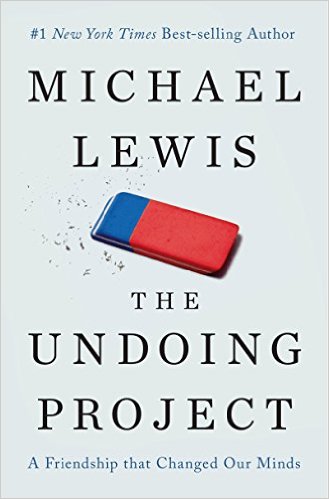
The Undoing Project - Michael Lewis ------------------ 4 Stars

I really struggled trying to figure out how many starts to give Michael Lewis' new book The Undoing Project. When I heard it was coming out a few months ago, I got very excited, which probably raised my expectations much too high. I finished it about a week ago and had it at lower than a 4 but in the past week, I've thought more about it, and it's moved back up. Let's get into why.

A little bit of background to help explain: this book is about two incredibly influential, but fairly unknown psychologists named Daniel Kahneman and Amos Tversky. A few years ago, I started reading a number of books about behavioral economics (Predictably Irrational, Nudge, and others). Basically, these two guys help create and make famous this new way of looking at decision making. If you are not a familiar with it, definitely check out this book. Basically, behavioral economics takes on normal economics, which assumes that each person acts logically, and puts a human overlay on it, which, study after study shows, people are not at all logical with money or decision making. In fact, they are often illogical. So, I've been really interested in this for the last few years and read Kahneman's comprehensive book, Thinking, Fast and Slow, a few years ago. Frankly, that book is fantastic and probably should have earned higher than 4 starts. When I heard that Michael Lewis, an author I usually enjoy reading (save the atrocious, Home Game) was writing about these two titans, I was very excited. 

Now to the problem, it's not actually the most exciting book. I'm not sure if my expectations were just too high, I knew too much already so most of this was not new, or if it's simply not a great book, but I really did not enjoy as much as I would have thought. I had two major problems. First, I was hoping to get more about the relationship between the two. Basically, it was one of the greatest partnerships in history, to the point neither actually could tell where the ideas were coming from at their peak. And while Lewis does a noble job at trying to detail their relationship, I never really felt it the way I was hoping.  He describes it in so many different ways but it still fell flat in truly adding clarity to the emotional part. Second, while he cherry picked some of the most interesting and noteworthy projects/studies they did, I had heard many of them before. The experiments are very interesting, but I thought he also did a poor job explaining just how far-reaching their research had become in the modern era.

So why did it end up with 4 stars? Because I have to think about the average reader who has never heard about Kahneman or Tversky, which is most of you! As this will be your first foray into behavioral economics, it could be a lot worst. In fact, the one added benefit of this book is that you get biographies (which truly is interesting) of these two fascinating scientists. However, if you want to get into a more meaty and thorough read and understanding of behavioral economics, then cut out the middle man and go straight to Kahneman's Thinking, Fast and Slow!  Either way, pick one of them up so you can at least understand all the poor decision making you currently are doing!

Sunday, February 15, 2015

The Big Short -- Michael Lewis ------------- 4 Stars

I think this is one of the stranger reviews and ratings I've done for a book.  It's safe to say that this is one of the most enjoyable books about something I did not understand.  In fact, I loved the book but again, didn't know what I was reading about half the time.  Alas, The Big Short is really worth the time if you are okay with you brain feeling a bit overwhelmed for much of it.

A bit of background, Michael Lewis is a pretty great author who wrote Moneyball, The Blind Side, and the original tale of Wall Street, Liar's Poker.  This book is sort of a take 2 on Liar's Poker.  It basically tells the story about the growth and eventual downfall of the housing crisis in the late 2000's.  To be even more clear, the book goes includes stories about a very small pool of people that were making systematic bets against the growth of the housing market.  These bets are calling 'shorting', hence the title, and can have great odds if they work out.  The final piece of info.: you make these bets against the housing market by buying collateralized debt obligations (or large numbers of mortgages put together into bonds).  Anyway, long summary short, Lewis walks you through how the housing book became so big, why no one was stopping it, why it was so easy to game (for the big banks), why those who bet against it were quite genius, and why, in the end, was it so sad for our society and country. 

The reason the book is so enjoyable, and earns such a high rating, relates to what I was joking about in the first paragraph.  What actually occurred was incredibly complex and confusing, and yet without even truly understand it, the reader (ME!) still gets a really good idea of what was happening and how absolutely crazy it was.  In some ways, it's kind of like a mystery novel, though with the ending already known.

Lewis does a great job of explaining why the banking machine was going so hard, so fast, and no one was asking questions and why the few that were asking questions were such outliers.  It also gave me such an amazing sense of the pressures of money on so many industries and especially on Wall Street.  The characters were also pretty fascinating.  While he doesn't go into great depth about them, he does describe about a dozen people that were absolutely critical in the process to short these companies and their investments in the housing market.

My only real complaint of the book (besides not actually understanding much of it) was that Lewis did not  explain the aftermath of many of the banks going belly up.  Although he writes briefly about the government step-ins and taking over of Freddie and Fannie, that's about it.  And though he does make it quite clear that there was huge mistakes in oversight by the government (e.g. Moody's which sets the 'ratings' for many of the collateralize mortgages, didn't know what they were doing and employed the meekest financial minds), you never really get a sense whose fault this is. He does mention how ridiculous it is that so many CEO's and VP's were highly compensated after losing millions of dollars, but I would have liked a final chapter explaining how to assure this never happens again.

Overall, it is a great story that is very well told and very illuminating.  You really get to better understand one of the largest black eye's in American financial history.  If you don't mind skipping over some things that just don't make sense to you, you're in for a real treat.  

Friday, August 13, 2010

Home Game -- Michael Lewis ---------------- 1.5 Stars

As some of you may know, I am pregnant. Well, I guess if you want to get technical about it, my wife is pregnant. I am going to be a father in a few months, and in the continuing effort to learn as much possible about the new addition, I have been educating myself about being a dad/having a child. Most of the books tend to be the very information yet incredibly boring baby books about pregnancy, giving birth, the first year, etc. Nothing I read in full nor want to review. So, I was quite excited when my wife recently gave me Michael Lewis' new book Home Game.

As you can tell from my 1.5 rating, I did not enjoy this book. This means one of three things: either I am going to hate being a father, this book sucks or Lewis is a fairly terrible dad (or perhaps a combination of the second two).

Let me explain. The book is basically this guys diary of clever and interesting (or so he thinks) anecdotes about the birth/early years of his three children. Now, I can't judge since I have never experience fatherhood before, but he makes being a dad sound awful. I mean, really not fun at all. Now, perhaps I'm all doe eyed and excited because my child is not here yet but this guy makes it sound like you are in a perpetual state of no sleep and no enjoyment, constantly worried and always looking to get away. At one point, he felt that the idea of killing a child really isn't that bad (I think he was joking).

Anyway, that's the major reason I didn't like this book. Second, the stories really aren't that entertaining or funny. In fact, his humor style I find most similar to Dave Barry (that's not a good thing). I love Lewis' other books -- Moneyball and Liar's Poker. He really should stick with stuff like that.

I guess the book wasn't all awful. It was short and easy to read. Occasionally it would be humorous, though nearly always it was when one of his young girls curses. That's about it.

In the end, it mostly left me confused. I was assuming there would be some great message or idea at the end, but I think it was literally his last diary entry. After listening to him rip on the idea of being a father for 200 pages, I was expecting a bit more of a happy ending. So, my confusion exists not knowing if this is what real fatherhood is and everyone else is sort of lying or if this guy is just painting a picture of being a fairly pathetic and unhappy father. I guess in time I will find out. Until then, I will err on the optimistic side and assume being father will be awesome and this guy should stick to writing about baseball and Wall Street.